Last Updated: April 2026
Western Australia follows the national 250 W e-bike standard and was one of the first states to adopt EN 15194 as a certification requirement. If your e-bike meets the Electrically Power-Assisted Cycle (EPAC) definition, it is treated as a regular bicycle in WA, with no registration and no licence required.
There is one notable difference from most other states: WA has a minimum riding age of 16 for e-bikes. Until Queensland’s proposed laws take effect in July 2026, WA is the only state with this restriction in place.
WA is also where Australia’s seize and crush framework originated. The NSW Government explicitly modelled its March 2026 seizure and crushing legislation on WA’s existing powers, making WA a quiet leader in e-bike enforcement.
This guide covers the specific rules for WA riders: what makes an e-bike legal, where you can ride, age restrictions, fines, and how to check compliance. For the national picture, see our hub article: E-Bike Laws in Australia (2026): Everything You Need to Know.
- Continuous power vs peak power
- E-bike throttle rules in Australia
- The 1000 W debate: what’s legal and what’s not
- Do you need insurance for an e-bike in Australia?
- What is EN 15194 certification?
Disclaimer: This article is for general information purposes only and should not be taken as legal advice. Always check with Transport WA or the Road Safety Commission for the most current requirements.
What Makes an E-Bike Legal in Western Australia?
WA recognises the same two categories of road-legal electric bicycle as the rest of Australia.
EPAC (Electrically Power-Assisted Cycle)
This is the standard for modern e-bikes. To qualify as a legal EPAC in Western Australia:
- Maximum continuous rated power: 250 W
- Pedal-assist only: The motor must provide assistance only while you are pedalling
- Speed cut-off: Motor assistance must progressively reduce and stop at 25 km/h
- Throttle: Walk-assist up to 6 km/h only. Above 6 km/h, the motor must only operate while you are pedalling
- Certification: Must be certified to EN 15194. WA was one of the first states to enforce this as a requirement
- Working pedals: The bike must have functional pedals
PAC (Power-Assisted Cycle)
The legacy 200 W category also remains legal. A PAC has one or more motors with a combined maximum continuous rated power of up to 200 W and can use a throttle without pedalling. These bikes are uncommon in the current market.
What is NOT legal
Any e-bike that exceeds 250 W continuous rated power, allows motor-assisted cruising above 25 km/h, or uses a throttle that propels the bike above 6 km/h without pedalling is classified as an unregistered motor vehicle in WA. This includes bikes that are “digitally limited” from a higher hardware rating. The motor stamp is what matters, not software settings.
For more on this distinction, read our article on continuous power vs peak power.
Minimum Age: 16 in Western Australia
WA is currently the only Australian state with an established minimum age for e-bike riders. You must be at least 16 years old to ride an e-bike in Western Australia.
This requirement has been in place for longer than any other state’s age restriction. Queensland is expected to introduce a matching minimum age of 16 from July 2026, and NSW is conducting an expert review that may recommend a minimum age between 12 and 16. But as of April 2026, WA and QLD (pending) are the only states with formal age limits.
There is no upper age limit. Riders of any age above 16 can ride a legal EPAC without a licence.
For children under 16, regular (non-electric) bicycles remain fully legal with no age restriction. Parents should be aware that allowing a child under 16 to ride an e-bike in WA is a breach of the regulations.
Where Can You Ride an E-Bike in WA?
A legal EPAC is treated as a bicycle. You have access to WA’s cycling infrastructure:
- Roads: Legal on all public roads where bicycles are permitted. Obey all traffic rules
- Bike lanes and cycleways: Full access to all bicycle lanes and dedicated cycle paths
- Shared paths: Legal. Ride at a safe speed, give way to pedestrians, and keep left
- Footpaths: Anyone can ride on a footpath in Western Australia, unless otherwise signed. An amendment to the Road Traffic Code 2000 brought WA into line with most other states on footpath riding. Riders must travel in single file on footpaths. Pedestrians always have right of way
- No-go areas: Motorways, freeways, and roads signed “No Bicycles” are off-limits
WA is one of the more permissive states for footpath riding. Unlike Victoria (where only children under 13 may use footpaths) and NSW (where adults are prohibited), WA allows all riders aged 16 and over to use footpaths, provided they ride responsibly and yield to pedestrians.
Fines and Penalties in WA
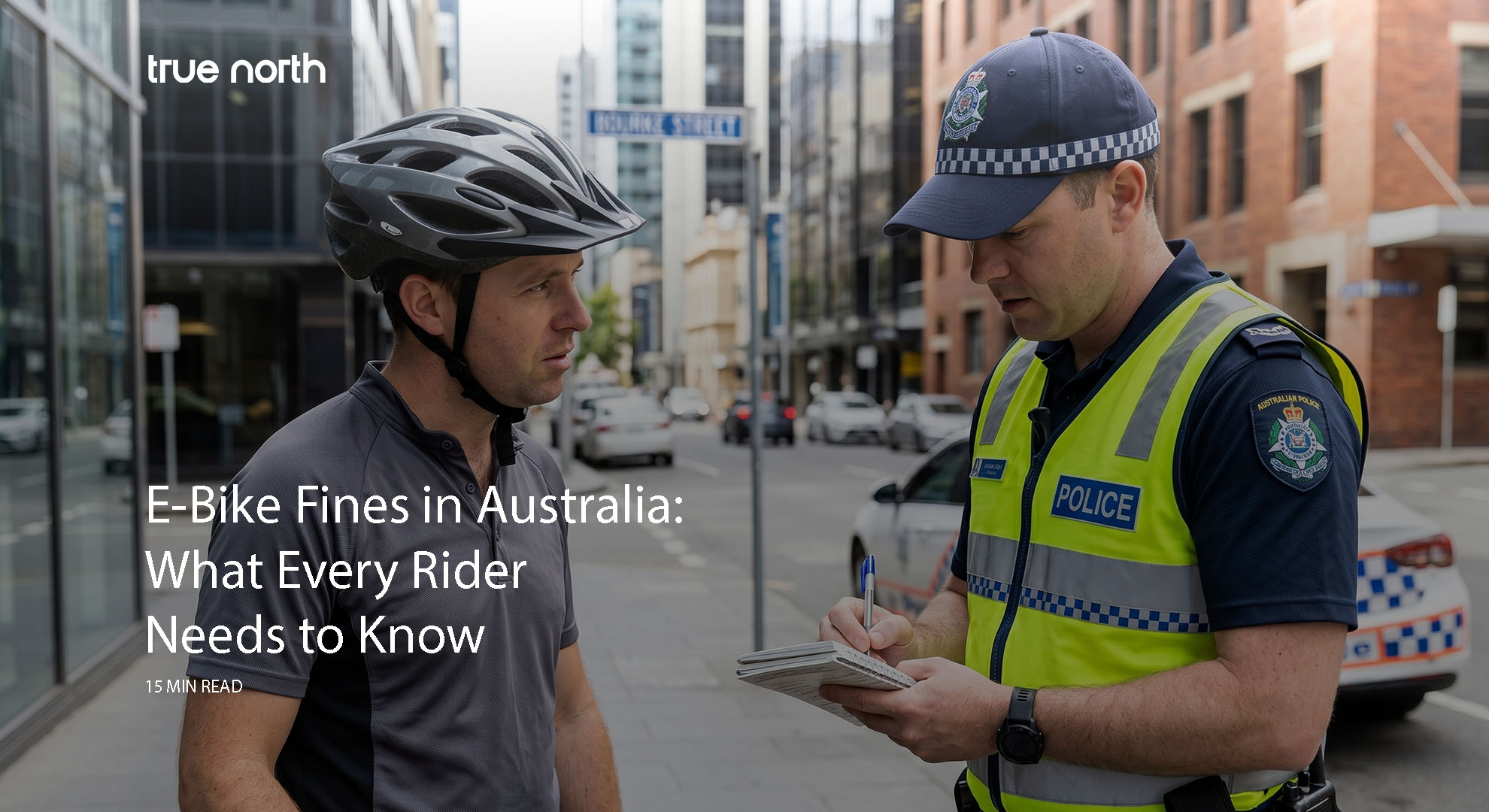
Riding a non-compliant e-bike in Western Australia is treated as operating an unregistered motor vehicle. WA has established enforcement powers including seizure of non-compliant devices.
Specific fines for e-bike-related offences in WA include:
- Exceeding 25 km/h on paths: $100
- Mobile phone use while riding: $500 to $1,000
- No helmet: fines apply (helmets are compulsory for all riders)
- Operating an unregistered motor vehicle: significant fines apply, with courts able to issue penalties up to $3,000 (25 penalty units)
- Seizure powers: WA police can seize non-compliant e-bikes. WA’s existing seize and crush framework was the model for NSW’s March 2026 legislation
Dangerous riding offences, including repeated non-compliance within five years, can lead to confiscation and destruction of the bike.
WA Was First: The Seize and Crush Model
Western Australia does not receive the same media attention as NSW or Queensland when it comes to e-bike enforcement, but the state has quietly led on one of the most significant enforcement tools in the country.
When NSW introduced the Road Transport Amendment (Non-registrable Motor Vehicles) Bill 2026 in March 2026, giving police the power to seize and crush illegal e-bikes, the government explicitly stated the legislation was based on similar seize and crush laws already in place in Western Australia.
WA’s framework allows police to confiscate non-compliant motorised vehicles (including overpowered e-bikes) on the spot. If the vehicle cannot be brought into compliance, it may be destroyed. This power has been in place before the current national enforcement push, making WA one of the toughest states for non-compliant e-bike riders, even though the crackdowns in NSW and Victoria tend to dominate the headlines.
How WA Compares to Other States
| Requirement | WA | NSW | VIC | QLD (from July 2026) |
|---|---|---|---|---|
| Power limit | 250 W | 250 W | 250 W | 250 W |
| Speed cut-off | 25 km/h | 25 km/h | 25 km/h | 25 km/h |
| Licence required? | No | No | No | Yes (learner’s minimum) |
| Minimum age | 16 | Under review | None | 16 |
| Footpath riding | Yes (all ages 16+) | Children only | Under 13 only | Yes (10 km/h limit from July) |
| Seizure powers | Yes (existing) | Yes (from March 2026) | Yes | Yes (from July 2026) |
| EN 15194 required | Yes (early adopter) | Yes (from Feb 2026) | Accepted | Referenced in bill |
WA stands out as an early adopter of both the EN 15194 standard and seizure powers. The state’s rules have been stable and consistent, which is an advantage for riders and retailers who have not had to navigate the kind of regulatory upheaval seen in NSW over the past two years.
Helmet and Equipment Requirements
- Helmet: Compulsory for all riders while in motion. Must meet approved standards. See the Road Safety Commission for details
- Lights: Required for riding at night or in poor visibility. White front light and red rear light, each visible from 200 metres
- Rear reflector: Red, visible from 50 metres
- Bell or warning device: Required to alert other path users
- Brakes: At least one functioning brake required. We recommend hydraulic disc brakes for reliable stopping power at e-bike speeds. See our e-bike brakes guide
Battery Safety
Like all Australian states, WA is affected by the Federal Government’s December 2025 import ban on non-compliant e-bikes. This ban ensures that new e-bikes entering Australia meet the EN 15194 standard, which includes battery safety testing.
When purchasing an e-bike or replacement battery in WA:
- Look for EN 15194 certification on the bike
- Check for the Regulatory Compliance Mark (RCM) on the charger
- Buy only from reputable suppliers
- Avoid aftermarket batteries and chargers from unverified online sellers
- Do not charge batteries overnight, near exits, or near flammable materials
For more on what EN 15194 covers, read our guide to EN 15194 certification.
Insurance in Western Australia
Insurance coverage for e-bike riders is not compulsory in WA. However, many cycling groups in Western Australia provide insurance cover as part of their membership, including personal accident and public liability cover.
WestCycle (WA’s peak cycling body) and AusCycling both offer memberships that include liability cover for riders of legal bicycles and EPACs. Some policies provide 24/7 coverage for riders of all ages (16+), while others cover only races, training, and events. Check with your specific organisation.
Your home and contents policy may also cover bicycle theft, but check for sub-limits and “motorised vehicle” exclusions that could apply to e-bikes. Call your insurer and ask directly.
If your e-bike is non-compliant, no insurance of any kind will cover you. Cycling membership cover, home insurance, and specialist bike policies all require the bike to meet the legal EPAC definition.
For the full breakdown, read our guide: Do You Need Insurance for an E-Bike in Australia?
How to Check If Your E-Bike Is Legal in WA
- Check the motor label. The continuous rated power must be 250 W or less. If it reads higher, the bike is not legal on WA roads, regardless of software settings
- Verify EN 15194 certification. Look for a permanent label showing the manufacturer’s name, “EPAC according to EN 15194,” the continuous rated power, the cut-off speed (25 km/h), a serial number, and the CE mark
- Test the throttle. The motor should only engage without pedalling at walking speed (up to 6 km/h). If the bike accelerates above 6 km/h on throttle alone, it is not compliant. See our throttle rules guide
- Confirm the rider’s age. The rider must be at least 16 years old in WA
- Ensure working pedals. A vehicle without functional pedals is not a bicycle
Frequently Asked Questions
Yes. E-bikes that meet the EPAC definition (250 W continuous, pedal-assist, 25 km/h cut-off, EN 15194 certified) are treated as bicycles in WA. No registration or licence is required. Riders must be at least 16 years old.
16 years old. WA is currently the only state with an established minimum age, though Queensland is expected to introduce the same minimum from July 2026, and NSW is reviewing its age requirements.
Yes. Anyone aged 16 and over can ride on footpaths in Western Australia, unless a sign specifically prohibits bicycles. Riders must travel in single file and give way to pedestrians.
You face fines for operating an unregistered motor vehicle, with court-imposed penalties reaching up to $3,000. Police can also seize non-compliant e-bikes, and in some cases the bike may be destroyed. WA’s seizure powers were the model for NSW’s March 2026 crush laws.
No. People aged 16 and over can ride a legal EPAC without any licence in WA. This differs from Queensland, which is introducing a learner’s licence requirement from July 2026.
Do I need insurance for my e-bike in WA?
It is not legally required, but it is recommended. Cycling organisations like WestCycle and AusCycling offer memberships with liability and personal accident cover. Check your home and contents policy for theft coverage, but be aware of potential “motorised vehicle” exclusions.
Summary
Western Australia’s e-bike laws are stable, clear, and well-established. The state was an early adopter of EN 15194 and has had seizure powers for non-compliant devices longer than any other state. The minimum age of 16 is currently unique to WA (with Queensland set to match from July 2026), and footpath riding is permitted for all riders aged 16 and over.
For WA riders, the rules are straightforward: ride a 250 W, EN 15194 certified, pedal-assist e-bike, wear a helmet, be at least 16, and you are legal on every road, bike lane, shared path, and footpath in the state.
For the full national picture, see our article: E-Bike Laws in Australia (2026): Everything You Need to Know. Or explore our range of EN 15194 certified e-bikes.
Official WA Sources: