Last Updated: April 2026
Victoria follows the national 250 W e-bike standard without exception. There has never been a higher-power exemption in this state, there is no transition period, and there are no plans to introduce one.
If your e-bike meets the Electrically Power-Assisted Cycle (EPAC) definition, it is treated as a regular bicycle. No registration, no licence, no compulsory insurance. If it exceeds the limits, it is classified as an unregistered motor vehicle, and Victoria Police are actively enforcing this. In 2025, Operation Consider found that 52% of e-bikes intercepted in Melbourne’s CBD were overpowered and non-compliant.
This guide covers the specific rules for Victorian riders: what makes an e-bike legal, where you can ride, what the fines are, and how to check your bike’s compliance. For the national picture, see our expanded article: E-Bike Laws in Australia (2026): Everything You Need to Know.
- Continuous power vs peak power
- E-bike throttle rules in Australia
- The 1000 W debate: what’s legal and what’s not
- Do you need insurance for an e-bike in Australia?
- What is EN 15194 certification?
- NSW e-bike laws
Disclaimer: This article is for general information purposes only and should not be taken as legal advice. Always check with Transport Victoria or Victoria Police for the most current requirements.
What Makes an E-Bike Legal in Victoria?
Victoria recognises two categories of road-legal electric bicycles. In practice, almost every modern e-bike sold today falls into the first category.
Category 1: EPAC (Electrically Power-Assisted Cycle)
This is the standard for all modern e-bikes. To qualify as an EPAC in Victoria, the bike must meet all of the following:
- Maximum continuous rated power: 250 W
- Pedal-assist only: The motor must provide assistance only while you are pedalling
- Speed cut-off: Motor assistance must progressively reduce and stop at 25 km/h. You can pedal faster under your own power, but the motor cannot help
- Throttle: Permitted only for walk-assist mode up to 6 km/h. Above 6 km/h, the motor must only operate while you are pedalling
- Working pedals: The bike must have functional pedals. A vehicle that cannot be pedalled is not a bicycle under Victorian law
Category 2: PAC (Power-Assisted Cycle)
This is a legacy category for older, lower-powered electric bicycles. A PAC has one or more motors with a combined maximum continuous rated power output of up to 200 W. PACs can use a hand-operated throttle without pedalling, because the power output is so low. These bikes are uncommon in the current market and exist primarily to cover older models.
What about bikes over 250 W?
Any e-bike that exceeds 250 W continuous rated power, allows motor-assisted cruising above 25 km/h, or has a throttle that propels the bike above 6 km/h without pedalling is not a bicycle under Victorian law. It is classified as an unregistered motor vehicle.
Victoria Police have been explicit about this. Any e-bike with a toggle switch or mechanism to override the legal power and wattage limits is also illegal to ride on public roads (Transport Victoria). This includes bikes that are “digitally limited” from a higher hardware rating.
For more on how continuous power is measured and why peak power is different, read our article on continuous power vs peak power.
Where Can You Ride an E-Bike in Victoria?
A legal EPAC is treated as a bicycle. You have access to Victoria’s cycling infrastructure without any special requirements:
- Roads: Legal on all public roads where bicycles are permitted. Obey all traffic rules including traffic lights, stop signs, and speed limits
- Bike lanes and cycleways: Full access to all bicycle lanes and dedicated cycle paths
- Shared paths: You can ride on shared pedestrian and bicycle paths. Keep left, give way to pedestrians, ride at a safe speed, and use your bell when passing
- Footpaths: Only children under 13 (and adults accompanying them) may ride on footpaths. Adults with a disability that necessitates footpath use are also exempt. If you are an adult in Melbourne, stick to roads, bike lanes, and shared paths
- Off-road trails: Permitted unless restricted by local council or Parks Victoria regulations. Check signage at specific parks and conservation areas
- No-go areas: Motorways, freeways, and roads signed “No Bicycles” are off-limits
There is no minimum age for riding an e-bike in Victoria. People of any age can ride a legal EPAC without a licence (Victoria Police). However, parents should assess their child’s ability to control the bike safely before allowing unsupervised riding.
How Victoria Differs from Other States
Victoria follows the national standard closely, but there are a few differences worth knowing if you travel interstate or are comparing state rules:
No 500 W exception (ever). NSW allowed 500 W e-bikes from 2023 until March 2026. Victoria never adopted this exception. A 500 W e-bike purchased legally in NSW was always illegal the moment it crossed the Victorian border.
Stricter footpath rules. Most other states (WA, SA, TAS, QLD, ACT, NT) allow riders of all ages on footpaths. Victoria restricts footpath riding to children under 13 and their accompanying adults.
No licensing requirement (currently). Queensland is expected to introduce a licensing requirement for e-bike riders from July 2026. Victoria has not proposed any similar measure. A legal EPAC rider in Victoria does not need any form of licence.
No registration scheme. In July 2025, Victorian Coroner Audrey Jamieson recommended that the government examine e-bike registration, including what she described as “methods that may seem radical.” In its formal response, the Department of Transport and Planning, alongside Victoria Police, did not support the introduction of a registration scheme. For now, legal EPACs remain unregistered bicycles.
Fines and Penalties in Victoria
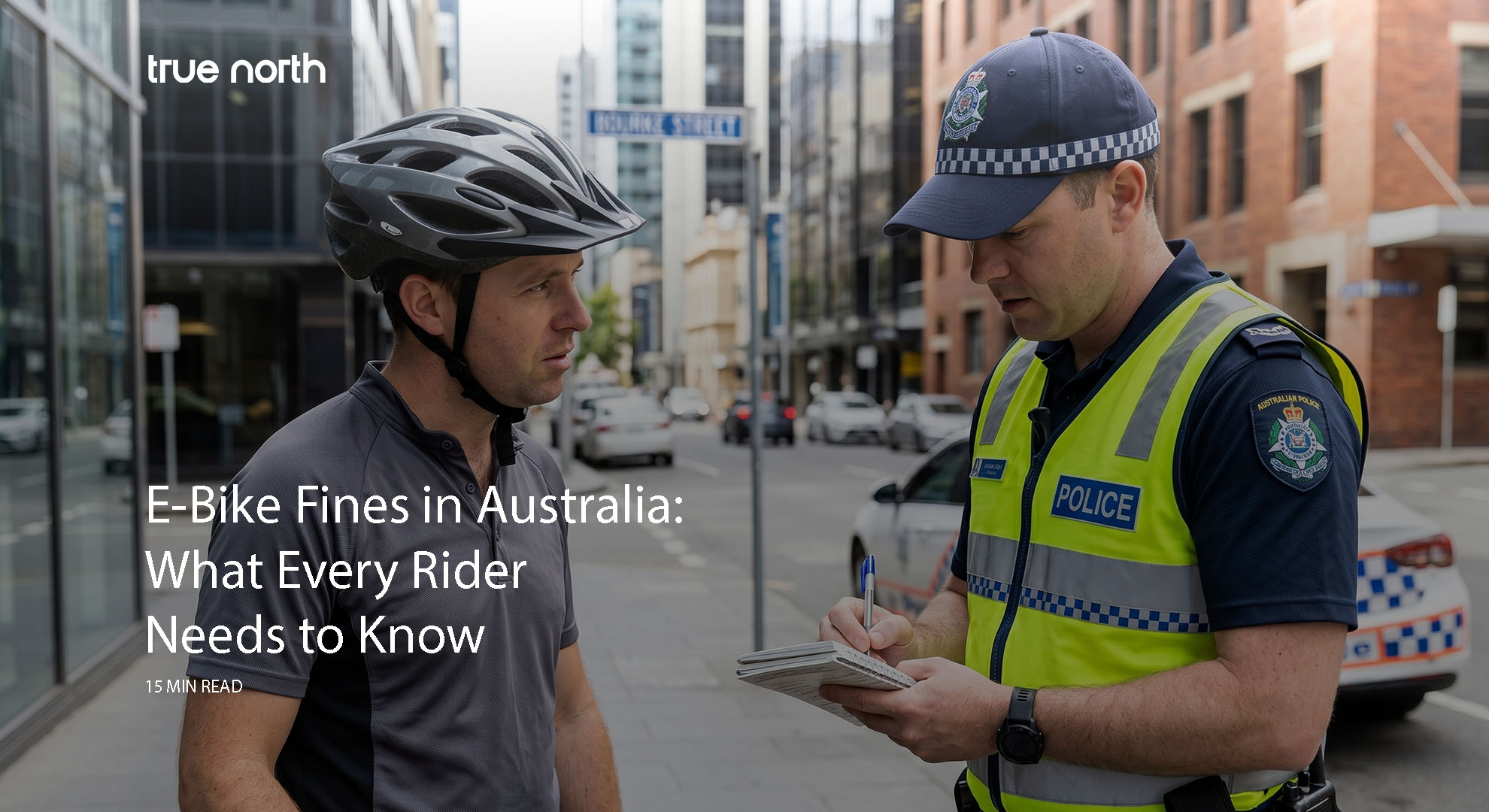
Victoria Police are actively enforcing e-bike compliance. Riding a non-compliant e-bike is treated as operating an unregistered motor vehicle, and the penalties are significant.
Operation Consider: The 2025 Melbourne Crackdown
In August 2025, Victoria Police launched Operation Consider, targeting illegal and overpowered e-bikes across Melbourne’s CBD. Members from the State Highway Patrol and Solo Unit teamed up with the North West Metro Bike Patrol, using foot patrols, bicycles, motorcycles, and highway patrol vehicles.
The results were striking. Police intercepted 274 road users, including 135 e-bikes. Of those e-bikes, 52% were found to be overpowered and non-compliant, making them unregistered vehicles. 44% of riders were classified as unlicensed. Police issued 257 infringements during the operation (Bicycle Network).
Road Policing Assistant Commissioner Glenn Weir said the results indicated “a clear lack of understanding or blatant disregard for compliance when it comes to e-bikes.” Police have confirmed that enforcement operations will continue.
Specific Fine Amounts
The following fines apply to e-bike riders in Victoria:
- Using an unregistered vehicle: $1,018
- Unlicensed riding (if the bike is classified as a motorcycle): additional fines apply
- Use of mobile phone while riding: $611
- Failure to obey traffic lights: $509
- Failure to wear a helmet: $254
- Speeding (under 10 km/h over the limit): $254
- Speeding (45 km/h or more over): $1,018 plus vehicle impoundment
Multiple fines can be stacked. A rider on an overpowered e-bike without a helmet who runs a red light could face over $1,700 in fines from a single intercept.
Victoria Police also use handheld speed detection devices. E-bike riders who exceed the speed limit face the same speeding penalties as motorists.
The Hastings Fatality
The enforcement push was partly driven by a high-profile incident. In May 2025, Hastings resident William Lothian was killed when he was struck by a rider on an allegedly illegally modified e-bike fitted with a 5,000 W motor. Police allege the rider was unlicensed and had methamphetamine in his system. The case underscored the gap between legal EPACs and the high-powered machines being sold as “e-bikes.”
Converted E-Bikes: Victoria’s Extra Rules
Victoria has specific rules about converted e-bikes, which are standard bicycles that have been fitted with aftermarket electric motor kits, controllers, and batteries.
A converted e-bike is legal to ride on public roads in Victoria only if it meets the same EPAC requirements: 250 W continuous, pedal-assist only, 25 km/h cut-off. In practice, many conversion kits exceed these limits.
Converted e-bikes also carry a higher fire risk due to DIY installations, poor wiring, low-quality components, and batteries that may not meet safety standards. For this reason, Victoria has taken an additional step that other states have not:
Converted e-bikes are banned from trains and public transport ticketing areas in Victoria, even if they were installed by a professional bicycle mechanic (Transport Victoria). Factory-built EPACs that meet EN 15194 or equivalent standards are not subject to this ban.
If you are considering a conversion kit, be aware that the finished product must comply with all EPAC requirements, and you will not be able to take it on the train. A factory-built EN 15194 certified e-bike avoids both issues.
Battery Safety
E-bike battery fires have become a growing concern in Victoria. Lithium-ion batteries can pose a fire risk if they are improperly manufactured, used, stored, or charged. Transport Victoria and Fire Rescue Victoria both recommend the following:
- Purchase e-bikes, batteries, and chargers only from reputable suppliers
- Look for compliance with EN 15194, UL2849, or AS/NZS 3820 standards, and the Regulatory Compliance Mark (RCM) on the charger
- Only use chargers that are supplied with the device or certified third-party equipment compatible with the battery specifications
- Do not charge batteries overnight or while unattended
- Do not charge near exits, on balconies, or near flammable materials
- Replace damaged batteries immediately and dispose of old batteries through proper recycling channels
The train ban on converted e-bikes was introduced specifically because of battery fire risk. This is an area where buying a factory-certified bike from a reputable brand provides genuine safety advantages over uncertified imports or DIY conversions.
Helmet, Lighting, and Equipment Requirements
The same road rules that apply to regular bicycles apply to e-bikes in Victoria:
- Helmet: Mandatory for all riders and passengers, at all times, on all roads and paths. Must meet AS/NZS 2063 or equivalent. The fine for riding without a helmet is $254
- Lights: Required for riding at night or in poor visibility. You need a steady or flashing white light visible from 200 metres at the front, and a steady or flashing red light visible from 200 metres at the rear
- Rear reflector: A red reflector visible from 50 metres is required at the rear
- Bell or warning device: Required to alert pedestrians and other path users
- Brakes: At least one working brake is required. Given the speeds e-bikes can reach, hydraulic disc brakes provide significantly better stopping power. For more on this, read our e-bike brakes guide
- No mobile phone use: You cannot use a handheld phone while riding. The fine is $611
How to Check If Your E-Bike Is Legal in Victoria
Use this checklist before purchasing or riding:
- Check the motor label. The continuous rated power must be 250 W or less. If the motor is stamped 500 W, 750 W, or 1,000 W, the bike is not legal on Victorian roads, regardless of any software restriction. For more on this, read our article on the 1000 W debate
- Verify EN 15194 certification. A compliant bike should display a permanent label showing: the manufacturer’s name, the words “EPAC according to EN 15194,” the motor’s continuous rated power, the cut-off speed (25 km/h), a serial number, and the CE mark
- Test the throttle. The motor should only engage without pedalling at walking speed (up to 6 km/h). If the bike accelerates above 6 km/h on throttle alone, it is not compliant. For more detail, see our throttle rules guide
- Check for toggle switches. Any bike with a switch or setting that allows the rider to override the 250 W or 25 km/h limits is illegal in Victoria, even if the override is not currently active
- Ensure working pedals. The bike must have functional pedals. If it looks more like a scooter with token pedals, it may not meet the definition of a bicycle
Insurance Considerations for Victorian Riders
Legal EPACs do not carry compulsory third-party insurance in Victoria. This means if you cause an accident and injure a pedestrian or damage property, you are personally liable.
Options for Victorian riders include joining AusCycling or Bicycle Network for public liability and personal accident cover (typically around $20 million liability cover for under $100 per year), taking out specialist e-bike insurance for theft and damage protection, and checking whether your home and contents policy covers bicycle-related incidents.
If your e-bike is non-compliant, you are effectively uninsurable. No cycling membership or home contents policy will cover an unregistered motor vehicle. For the full breakdown, read our guide: Do You Need Insurance for an E-Bike in Australia?
Frequently Asked Questions
Yes. E-bikes that meet the EPAC definition (250 W continuous rated power, pedal-assist only, 25 km/h cut-off) are treated as bicycles in Victoria. No registration, no licence. People of any age can ride a legal EPAC. Bikes that exceed these limits are classified as unregistered motor vehicles and carry fines of $1,018 or more.
No. Victoria has never allowed e-bikes above 250 W continuous rated power. NSW was the only state that temporarily allowed 500 W, and that exception was repealed in March 2026. A 500 W e-bike is an unregistered motor vehicle in Victoria and has always been one.
Only if you are under 13, or you are an adult accompanying a child under 13. Adults with a disability that necessitates footpath use are also exempt. All other adults must ride on roads, bike lanes, or shared paths.
The primary fine is $1,018 for operating an unregistered vehicle. Additional fines may apply for unlicensed riding, failure to wear a helmet ($254), mobile phone use ($611), and traffic signal offences ($509). Multiple fines can be stacked in a single intercept.
No. People of any age can ride a legal EPAC without a licence in Victoria. However, if your e-bike is classified as an unregistered motor vehicle (because it exceeds 250 W or 25 km/h), you could face unlicensed driving charges in addition to the unregistered vehicle fine.
Factory-built EPACs that meet safety standards are generally permitted on trains, though space is limited and conditions apply. Converted e-bikes (standard bicycles fitted with aftermarket motor kits) are banned from trains and public transport ticketing areas in Victoria due to battery fire risk.
No. In 2025, a Victorian coroner recommended the government examine e-bike registration, but the Department of Transport and Victoria Police both declined to support a registration scheme. Legal EPACs remain unregistered bicycles.
Summary
Victoria’s e-bike laws are straightforward: 250 W, pedal-assist, 25 km/h cut-off. There has never been a higher-power exception, and there are no plans for one. The rules have not changed, but enforcement has intensified significantly. Operation Consider in 2025 found that more than half the e-bikes intercepted in Melbourne’s CBD were non-compliant, and Victoria Police have confirmed ongoing enforcement operations.
The safest approach for any Victorian rider is to choose a 250 W, EN 15194 certified e-bike. It is legal on every road, bike lane, and shared path. It is insurable. It can travel on trains. And it will not attract the attention of police who are increasingly equipped to identify non-compliant bikes.
For the full national picture, see our article: E-Bike Laws in Australia (2026): Everything You Need to Know. Or explore our range of EN 15194 certified e-bikes.
Official Victorian Sources: