Last Updated: June 2026
Australia has embraced e-bikes, and for good reason: they’re fast, practical and, in many suburbs, simply the easiest way to get around. Yet the rules can feel overwhelming when you’re standing in a shop comparing motors, speed limits and features like throttles. The landscape is shifting faster than ever.
2026 is the most significant year for Australian e-bike regulation in a decade. NSW is phasing out its 500 W exception, moving to the national 250 W EN 15194 standard from 1 March 2029, with 500 W bikes remaining road-legal in the meantime. Queensland has introduced sweeping new laws to parliament that, if passed, will take effect from 1 July 2026, including a licensing requirement and a ban on riders under 16. The government holds a majority, so the legislation is expected to pass.And the Federal Government’s import ban is stopping non-compliant bikes at the border.
This guide gives you the simple, practical version of what’s legal on public roads and paths today, with direct links to official government sources so you can verify details for your state. When you want a deeper dive, we’ve also written focused explainers on the most confusing topics:
- Continuous power vs peak power
- E-bike throttle rules in Australia
- The 1000 W debate: what’s legal and what’s not
- Do you need insurance for an e-bike in Australia?
- What’s the legal watt limit in Australia?
- What is EN 15194 certification?
Jump to your state: NSW | Victoria | Queensland | Western Australia | South Australia | Tasmania | ACT | Northern Territory
Disclaimer: This article is for general information purposes only and should not be taken as legal advice. E-bike regulations vary across states and territories. Always check your local laws before riding.
What Counts as an E-Bike in Australia?
The law recognises one primary category of road-legal e-bike: the Electrically Power-Assisted Cycle, often called an EPAC or pedelec. If your bike meets the EPAC definition, it is treated as a bicycle under Australian law, no registration, no licence, no compulsory insurance required.
By definition, an EPAC is a bicycle equipped with a motor that provides assistance only while you are pedalling. The motor’s assistance must progressively reduce as you gain speed and stop entirely once the bike hits 25 km/h. You can still pedal faster than 25 km/h under your own power, the motor simply won’t help you get there.
The maximum motor output for an EPAC is defined in terms of continuous rated power:
- Nationwide standard: The limit is 250 W continuous in every state and territory.
- The NSW update: NSW currently allows EPACs up to 500 W, but this exception is being phased out. From 1 March 2029, NSW follows the national 250 W standard. A 500 W bike stays road-legal in NSW until then, though only 250 W EN 15194 models are legal in other states (see the NSW section below for full details).
Continuous power is the output the motor can sustain indefinitely under standard test conditions. It’s the number printed on the motor housing and it’s the number regulators care about, not peak power, which is a short burst for hill starts. For more on this distinction, read our detailed article on continuous power vs peak power.
A 250 W EPAC certified to EN 15194 is universally road-legal nationwide and is the only future-proof choice for new buyers.
Does Limiting a 1,000 W E-Bike Make It Legal?
No. If the motor’s hardware is stamped above the legal limit, a software cap does not change its legal classification. You are riding what the law treats as a motorbike, without registration, without insurance, and often without the appropriate licence.
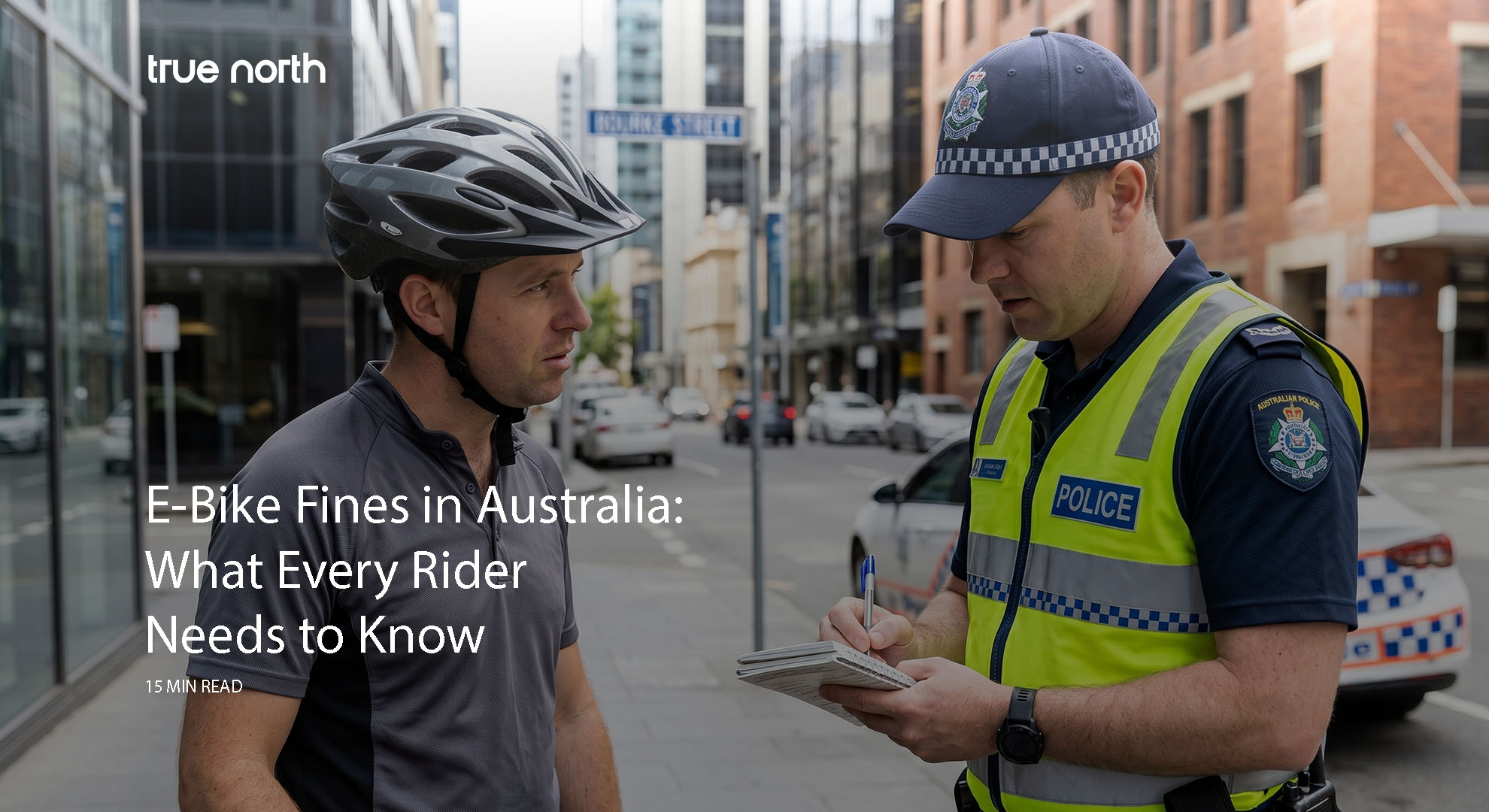
Police crackdowns in multiple states have made this explicit. In Queensland, a father in Mackay was fined over $700 for allowing his 15-year-old son to ride a high-powered modified e-bike on public streets (ABC News). In New South Wales, “Operation Kilowatt” on Sydney’s Northern Beaches saw 28 non-compliant e-bikes identified in one month, with fines of $818 issued for each illegal e-bike use (Northern Beaches Advocate). Bikes were seized on the spot, and riders were also fined for other offences such as $410 for not wearing a helmet. Victoria Police have warned that any e-bike exceeding 250 W/25 km/h will be treated as an unregistered motor vehicle, meaning riders can be fined for driving unregistered and for driving without a licence (VIC Police).
The consumer risk is real. Retailers and online sellers often fail to make these distinctions clear, and some continue to market fat tyre e-bikes or DIY kits boasting 1,000+ watts. Don’t fall for the hype. In Australia, anything above the 250 W EPAC standard is not legally an e-bike, it’s either a moped or motorbike in the eyes of the law.
For more detail, read our articles on the legal watt limit in Australia and the 1,000 W debate.
Throttles: What’s Allowed and What Isn’t
One of the simplest ways to test whether your bike is a true EPAC is this: does the motor stop when you stop pedalling?
Australian e-bike rules tightly restrict throttle usage. On a legal EPAC, throttles are permitted under two specific conditions:
- Walk Assist: A throttle may propel the bike from a standstill without pedalling, but it must cut out strictly at 6 km/h.
- Pedal-Activated Boost: A throttle or boost button may provide power at higher speeds (up to 25 km/h), but only while you are simultaneously pedalling. The moment you stop pedalling, the motor must stop.
If your throttle allows you to sit on the seat, twist the grip, and cruise at 25 km/h without your legs moving, the vehicle is no longer classified as a bicycle. It is an unregistered motorbike. All states and territories now uniformly apply these throttle rules.
For a full breakdown of throttle types, testing tips, and the pedal-boost distinction, read our article on e-bike throttle rules in Australia.
E-Bike Laws by State and Territory
While the national standard of 250 W / 25 km/h / pedal-assist applies everywhere, each state has its own nuances around footpath access, age restrictions, enforcement, and, in the case of NSW and QLD, significant 2026 changes. Here’s what you need to know for your state.
New South Wales (NSW)
NSW is phasing out its unique 500 W allowance to align with the rest of Australia and the international EN 15194 standard. Under the NSW Road Rules, a 500 W EPAC remains legal to ride until 1 March 2029, after which only 250 W EN 15194-certified bikes will be road-legal. The bigger near-term change is at the point of sale: from February 2026 new e-bikes must be electrically safety-certified. From late 2025, NSW began a staged transition. Three separate regulatory layers apply, and they do different things:
- 1 February 2026 (Fair Trading certification): A mandatory electrical-safety framework began. All e-micromobility products, batteries and chargers sold in NSW must be tested, certified and marked. This targets lithium-ion fire and electrical safety, not motor power. (NSW Government).
- December 2025 (Federal import rules): The Commonwealth reinstated the EN 15194 reference into import guidance, making it much harder to import new e-bikes rated above 250 W as bicycles.
- March 2026 (Seizure and crushing powers): The Road Transport Amendment (Non-registrable Motor Vehicles) Act gave police power to seize, and in some cases crush, e-bikes that perform like motorbikes. (NSW Government).
The on-road power limit itself has not changed. Under the NSW Road Rules, a 500 W e-bike remains legal to ride until 1 March 2029, when the 250 W EN 15194 standard takes full effect.
A 500 W bike remains legal to ride in NSW until 1 March 2029, whenever it was bought. There is no purchase-date condition on road legality. On that date, all e-bikes over 250 W (or that don’t meet EN 15194) become illegal to ride on public roads, regardless of when they were purchased.
For retailers, selling e-bikes, batteries or chargers that aren’t electrically safety-certified carries fines of up to $825,000. This certification is about fire and electrical safety, not a power cap, so it doesn’t by itself ban a 500 W bike. In practice, though, tightened federal import rules and the market shift to EN 15194 mean new 500 W stock is drying up fast. Whether a specific 500 W model can still be retailed depends on its certification status, so confirm current requirements with NSW Fair Trading and Transport for NSW.
Footpaths: Adults cannot ride on footpaths in NSW. Children under 16 (and adults accompanying them) may ride on footpaths.
What to buy: If you are looking at a bike today, choose one with the EN 15194 sticker and a 250 W rating. A 500 W bike is road-legal in NSW until 2029 but won’t be compliant after that, and isn’t legal in any other state. A 250 W EN 15194 certified model is the only option that is legal now, remains legal beyond 2029, and is road-legal in every other state if you travel interstate.
- For more detail, see our NSW e-bike laws guide.
- Official source: Transport NSW: E-Bikes
Victoria (VIC)
Victoria follows the national 250 W standard without exception. There has never been a higher-power exemption in this state.
To be road-legal in Victoria, your e-bike must be pedal-assist only, have a maximum continuous rated power of 250 W, and the motor must cut out at 25 km/h. A throttle is permitted only for walk-assist up to 6 km/h. Victoria Police have explicitly stated that any e-bike exceeding these limits will be treated as an unregistered motor vehicle, with fines for both unregistered driving and unlicensed driving (VIC Police).
Footpaths: Only children under 13 (and adults accompanying them) may ride on footpaths. Adults with a disability that necessitates footpath use are also exempt. If you’re an adult in Melbourne, stick to roads, bike lanes, and shared paths.
Official source: VicRoads: Electric Bikes
Queensland (QLD): Major Changes from 1 July 2026
Queensland has introduced the most sweeping e-bike law reforms in the country to parliament. The government holds a majority and the legislation is expected to pass, with changes taking effect from 1 July 2026 and a six-month transition period to follow.
The reforms follow a parliamentary inquiry into e-mobility safety prompted by 12 deaths in e-device incidents across Queensland in 2025 alone, including several children. More than 6,000 people presented to hospital with e-mobility injuries between 2022 and 2025 (Bicycle Network).
Here’s what changes from 1 July 2026:
- Licensing requirement: All e-bike riders over 16 must hold at least a learner’s driver’s licence (cost: $77.55 for three years). E-wheelchair users are exempt.
- Minimum age of 16: Riders under 16 will be banned from riding e-bikes. Parents who allow their under-16 children to ride face fines.
- Fines: Fines range from $330 to $6,700 depending on the offence, covering non-compliance, carrying passengers, riding without a helmet, and more (Newsport Daily).
- Seizure and destruction powers: Police can seize and destroy non-compliant or illegally modified e-bikes.
- Random breath testing: E-bike riders will be subject to random breath testing for the first time.
- Footpath speed limit: A 10 km/h speed limit will apply on all footpaths.
- Road access expanded: Riders will be permitted on roads with speed limits up to 60 km/h, encouraging a shift from footpaths to roads.
- Hooning offences: New offences target riders who organise meets to film and post illegal riding on social media.
These are significant changes. If the legislation passes as expected, riders in Queensland will need a valid learner’s licence or above from 1 July. The power and pedal-assist requirements remain unchanged: 250 W, 25 km/h, pedal-assist, EN 15194 certified.
There is ongoing debate about these reforms. Bicycle Queensland has raised concerns that linking e-bike use to a driver’s licence is a poor fit for what is essentially a bicycle, and industry groups have flagged potential impacts on tourism, delivery riders, and e-bike hire schemes. The legislation is before parliament and expected to pass given the government’s majority. We’ll update this section once the final rules are confirmed.
Footpaths: Currently permitted for all ages. If the legislation passes, a 10 km/h speed limit will apply from July 2026 and riders must not ride near pedestrians without due care.
Official source: QLD Government: Electric Bicycle Rules
Western Australia (WA)
Western Australia follows the national 250 W / 25 km/h standard and was one of the first states to adopt EN 15194 as a requirement.
Age restriction: WA is the only state (aside from QLD’s incoming changes) with an existing minimum age. Riders must be at least 16 years old.
Footpaths: Riding on footpaths is permitted for all ages (subject to the age restriction above). Pedestrians always have right of way.
Official source: Transport WA: Riding, Walking & Wheeling
South Australia (SA)
South Australia follows the national standard: 250 W, 25 km/h, pedal-assist only.
Footpaths: Riding on footpaths is permitted for all ages unless a sign specifically prohibits bicycles. Pedestrians always have right of way.
Official source: SA Government: Power Assisted Bicycles
Tasmania (TAS)
Tasmania follows the national standard: 250 W, 25 km/h, pedal-assist only.
Footpaths: Riding on footpaths is permitted for all ages. Pedestrians always have right of way.
Official source: Transport TAS: E-Bikes
Australian Capital Territory (ACT)
The ACT follows the national standard: 250 W, 25 km/h, pedal-assist only.
Footpaths: Riding on footpaths is permitted for all ages unless a sign specifically prohibits bicycles.
Official source: ACT Government: Walking and Cycling
Northern Territory (NT)
The Northern Territory follows the national standard: 250 W, 25 km/h, pedal-assist only.
Footpaths: Riding on footpaths is permitted for all ages.
Official source: NT Government: Electric Scooters and Bikes
Where Can You Ride Your E-Bike?
An e-bike that meets the EPAC definition is treated as a bicycle, which gives you access to the vast network of cycling infrastructure without a licence or registration. Here’s the general breakdown:
- Roads: Legal e-bikes can be ridden on public roads, just like a regular bicycle. Obey all road rules: traffic lights, signs, speed limits. Motorways, highways, and roads signed “No Bicycles” are off-limits.
- Bike lanes and cycleways: E-bikes are welcome in all bike lanes and dedicated cycle paths.
- Shared paths and trails: You can ride on shared pedestrian/bicycle paths. Keep left, give way to pedestrians, ride at a safe speed (many shared paths enforce a 10–25 km/h limit), and use your bell when passing. Check local council rules for specific parks or conservation areas, as a small number restrict e-bikes.
- Footpaths: This varies by state (see your state section above). In NSW and Victoria, only children may ride on footpaths. In most other states, all ages are permitted.
- No-go areas: Any road or path signed “No Bicycles” is off-limits. Any e-bike that doesn’t meet the EPAC definition is restricted to private property only.
Helmet, Lighting and Equipment Requirements
Australian law requires the same road rules and equipment standards for e-bikes as for any bicycle:
- Helmet: Mandatory in every state and territory. Must meet AS/NZS 2063 or equivalent. Fines for not wearing one can be steep, for example $410 in NSW.
- Brakes: At least one functioning brake is required. Given the speeds e-bikes can reach, we recommend hydraulic disc brakes for reliable stopping power. For more on this, see our e-bike brakes guide.
- Bell or warning device: Required by law to alert pedestrians and other cyclists.
- Lights and reflectors: Required for riding at night or in low visibility. You need a white light in front and a red light at the rear (each visible from 200 metres), plus a red rear reflector (visible from 50 metres). Even in daytime, running lights can improve your visibility on busy roads.
Fines and the Cost of Non-Compliance
Enforcement is tightening across the country. Riding an illegal e-bike is treated as operating an unregistered motor vehicle, and the consequences are serious:
- Fines typically start at several hundred dollars per offence. NSW’s Operation Kilowatt issued $818 per illegal e-bike use. Queensland fines under the new July 2026 laws will range from $330 to $6,700. Victoria can stack multiple fines (unregistered vehicle + unlicensed driving) to exceed $800 combined.
- Seizure and destruction: NSW and QLD (from July 2026) give police powers to confiscate non-compliant e-bikes on the spot. NSW is trialling portable “dyno units” for roadside speed and power testing. In some cases, seized bikes are crushed, they won’t be returned.
- Licence consequences: Riding a high-powered e-bike without the appropriate motorcycle licence can result in unlicensed driving charges. If you do hold a driver’s licence, offences may affect your driving record.
- Insurance void: Without compulsory third-party insurance, you are personally liable for any injuries or damage you cause. A collision with a pedestrian could result in claims in the tens or hundreds of thousands of dollars, with no policy to fall back on.
The trend across every state is clear: play by the rules or pay the price.
The Insurance Gap Nobody Talks About
Because legal e-bikes are classified as bicycles, they don’t carry compulsory third-party insurance. This has benefits (no rego fees, no CTP premiums) but it also means if you cause an accident, there’s no automatic policy covering injuries or damage.
If you collide with a pedestrian or damage a car, you are personally liable. That could be financially devastating. And if your e-bike is illegal, no insurer will cover you at all. Riding an unregistered motor vehicle voids any existing policy.
The good news is that options exist: cycling organisation memberships (like Bicycle NSW or AusCycling) typically include public liability cover, specialist e-bike insurers offer theft and damage policies, and some home and contents policies extend to bicycle accidents. It’s worth checking.
For a complete breakdown of your options, read our detailed guide: Do You Need Insurance for an E-Bike in Australia?
Consumer Checklist: How to Buy a Legal E-Bike
Standing in a shop or browsing online, use this checklist to ensure your new bike is both legal and safe:
- Check the motor label. Look for the compliance sticker or stamp on the motor housing. It should clearly state the continuous rated power. If it reads 250 W, you’re legal in every state, now and beyond 2029. If it reads 500 W, it is road-legal in NSW until 1 March 2029 but not in any other state, and it won’t meet the standard after that date, so it isn’t a future-proof buy. If it reads 750 W or 1,000 W, walk away, unless you plan to use it strictly on private property.
- Verify the speed cut-off. A legal EPAC cuts motor assistance at 25 km/h. Ask the retailer to demonstrate this. Be wary if a seller offers to “unlock” the bike for more speed, politely decline if you plan to ride on public roads.
- Look for EN 15194 certification. This is the European standard that confirms the bike is a legal EPAC. It tests safety (frame strength, battery reliability, electrical systems) and road compliance (250 W power, 25 km/h cut-off, pedal-assist requirement). A bike with the latest EN 15194 certification is road-legal in every state and territory. For more on what this certification covers, read our guide to EN 15194 certification.
- Test the pedals. An “e-bike” without functional pedals, or one where you’re clearly not meant to pedal, is not an e-bike under Australian law. If it looks more like a scooter with token pedals, be cautious.
- Ignore “digitally limited” claims. If a seller says a 1,000 W bike is “limited to 250 W via settings,” the law disagrees. Authorities assess the designed and marked continuous rating on the hardware, not changeable software. The motor stamp is what an inspector, insurer, or court will rely on.
Why It Matters
Legal EPAC e-bikes are designed to integrate seamlessly into bicycle traffic, they give you a helpful boost, but not so much power that you’re a hazard on shared paths. The 25 km/h assist limit keeps e-bikes in the same speed range as fit cyclists. The 250 W power cap ensures modest, bicycle-like acceleration.
In return for staying within these limits, you get significant freedoms: no licence, no registration, no road tax, access to bike lanes and shared paths, and no mandatory insurance costs. It’s a deal worth keeping.
The alternative is a future where high-profile incidents involving overpowered bikes lead to a public backlash and tighter restrictions that affect everyone. QLD’s sweeping July 2026 reforms are a direct response to exactly this : 12 deaths and thousands of hospitalisations driving a political mandate to crack down. Other states will be watching closely.
If you need more speed or power, that’s what electric motorcycles and mopeds are for, and plenty of good ones are hitting the Australian market.
Frequently Asked Questions
Yes. E-bikes that meet the Electrically Power-Assisted Cycle (EPAC) definition are treated as bicycles in every state and territory. This means a maximum of 250 W continuous rated power, pedal-assist only (with throttle limited to 6 km/h walk-assist), and motor cut-off at 25 km/h. No licence, registration, or insurance is required for a compliant e-bike.
Are 500 W e-bikes legal? Only in NSW, and only until 1 March 2029. NSW is the one state that allows EPACs up to 500 W, and a legal 500 W bike remains road-legal to ride there until that date, whenever it was bought. From 1 March 2029, NSW moves to the 250 W EN 15194 standard. In every other state, 500 W has always been illegal for road use. The Federal Government has also tightened imports of e-bikes over 250 W since December 2025. Because a 500 W bike isn’t legal interstate and won’t be legal in NSW after 2029, a 250 W EN 15194 model is the only future-proof choice for a new purchase.
Yes. Police in NSW, Victoria, Queensland (from July 2026), and WA have powers to seize e-bikes suspected of being non-compliant. In NSW, police are trialling portable dyno units for roadside speed and power testing, and seized bikes may be crushed. In Queensland, new laws from July 2026 give police expanded seizure and destruction powers, with fines of up to $6,700.
From 1 July 2026, Queensland is expected to require all e-bike riders over 16 to hold at least a learner’s driver’s licence. The legislation is before parliament and the government holds a majority. Riders under 16 will be banned. Fines range from $330 to $6,700. Police will gain powers to seize and destroy non-compliant devices, conduct random breath testing, and enforce a 10 km/h footpath speed limit. New hooning offences also apply.
EN 15194 is the European standard for Electrically Power-Assisted Cycles. It tests both safety (frame, battery, electrical systems) and road compliance (250 W power limit, 25 km/h cut-off, pedal-assist requirement). It is the standard accepted in every Australian state and territory, and it’s now the standard required by federal import laws. A bike with EN 15194 certification is road-legal nationwide.
It’s not legally required, but it’s strongly recommended. Because e-bikes are classified as bicycles, they don’t carry compulsory third-party insurance. If you cause an accident, you’re personally liable for injuries and damage, potentially tens or hundreds of thousands of dollars. Options include cycling organisation memberships, specialist e-bike insurance, and checking your home and contents policy. Read our full guide: Do You Need Insurance for an E-Bike in Australia?
Summary
Australia’s e-bike laws are converging on a single, clear standard: 250 W continuous rated power, pedal-assist only, with motor cut-off at 25 km/h, certified to EN 15194. NSW is adopting this standard from 1 March 2029, with 500 W bikes remaining road-legal in the meantime. Queensland’s sweeping July 2026 reforms, if passed as expected, add licensing, age restrictions, and significantly tougher penalties. And the Federal Government’s import ban is clearing non-compliant bikes from the market at the source.
If your motor is factory-rated at 250 W continuous and certified to EN 15194, you are in the safe zone nationwide, today and tomorrow. Anything beyond that, including high-powered imports, software-limited bikes, and throttle-only machines, puts you at risk of fines, liability, and confiscation.
The smartest move in 2026 is simple: buy a 250 W, EN 15194 certified e-bike and ride with confidence. For more on what makes a bike legal, read our complete guide to legal e-bikes in Australia or explore our range of EN 15194 certified e-bikes.