Last Updated: May 2026
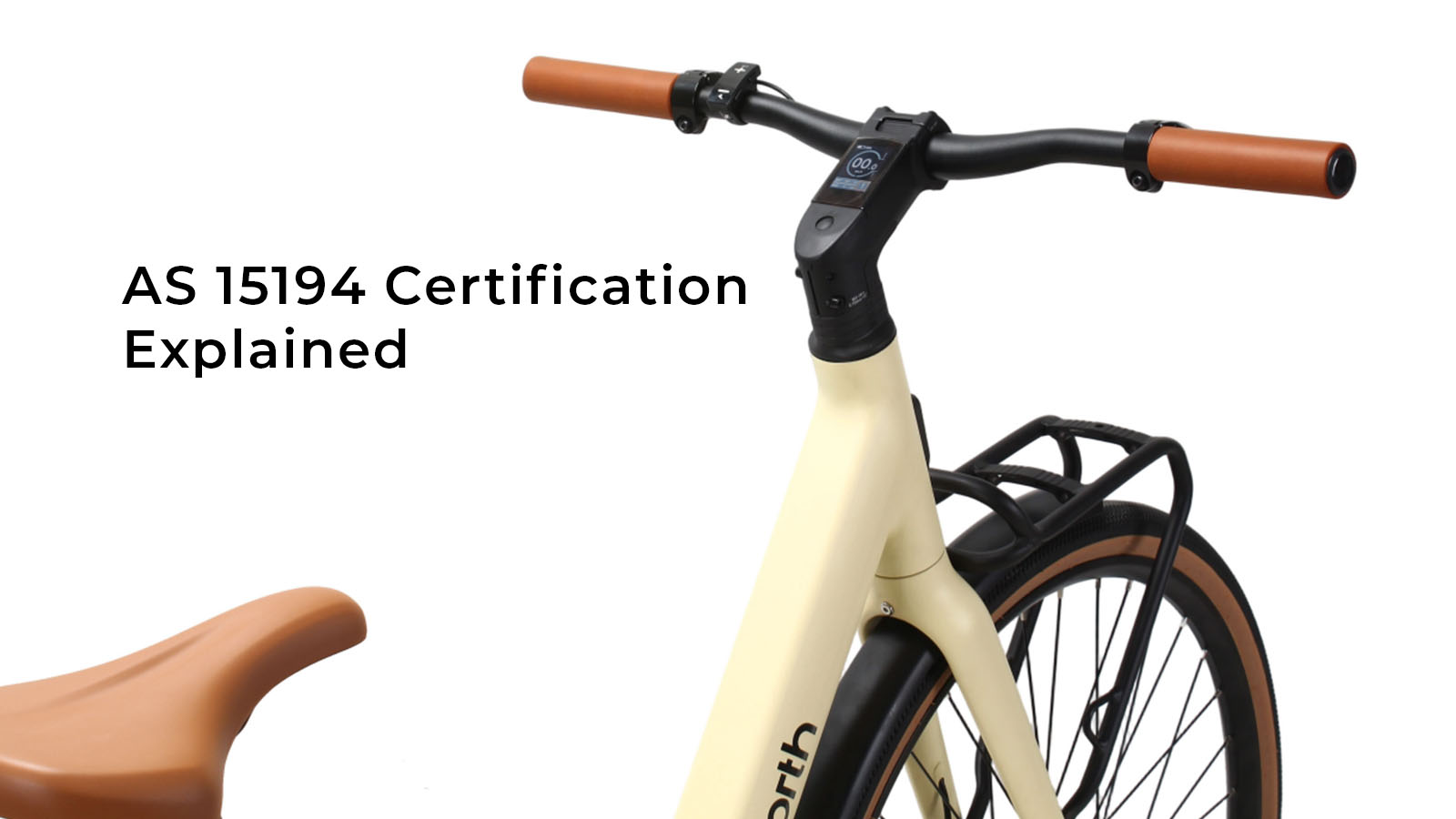
If you’re shopping for a safe and legal e-bike, you’ve probably seen certifications such as EN 15194, the European standard for 250 W Electrically Power-Assisted Cycles (EPACs), or UL 2849, the American electrical-safety system that verifies wiring, battery, and charger integrity. Australia also has its own certification: AS 15194.
AS 15194 is the Australian adaptation of the European EN 15194 standard, aligned with local AS/NZS 60335 electrical-safety requirements. For 250 W EPACs, it is functionally identical to EN 15194 and is fully accepted as proof of compliance in every state and territory.
Historically, AS 15194 also covered e-bikes up to 500 W continuous rated power in NSW, where the higher limit applied. That pathway is now effectively closed. NSW repealed its 500 W allowance in March 2026, and the Federal Import Ban (December 2025) prevents non-compliant bikes from entering the country. Going forward, AS 15194 is a 250 W standard in practice, just like EN 15194.
This article explains what AS 15194 tests, how it fits alongside EN 15194 and UL 2849, and what it means for buyers in 2026. For the full comparison of all three standards, see our E-Bike Certification Standards guide. For the broader legal framework, see our hub article: E-Bike Laws in Australia (2026).
- What is EN 15194 certification?
- How to buy a legal e-bike in Australia
- Continuous vs peak power
- NSW e-bike laws
Disclaimer: This article is for general information purposes only and should not be taken as legal advice. Always check your local laws before riding.
What AS 15194 Certification Means
AS 15194 defines how an e-bike must be designed, built, and tested to meet Australian safety and performance expectations. It builds upon EN 15194 by adding clauses from AS/NZS 60335, ensuring e-bikes meet the same rigorous electrical-safety standards as other household and mobility products sold in Australia.
A certified e-bike under AS 15194 must:
- Provide pedal-assist only, with motor support cutting out at 25 km/h
- Use a continuous rated power no higher than 250 W (the 500 W pathway is now closed for new sales)
- Deliver consistent braking and structural integrity under load
- Meet electromagnetic-compatibility (EMC) requirements
- Display correct labelling and traceable compliance documentation
Testing is conducted by accredited laboratories such as TÜV Rheinland and SGS, which issue formal compliance reports and certification plates once a model passes.
The 500 W Pathway: Now Closed
AS 15194 was historically unique among the three Australian-accepted certification standards because it could certify e-bikes up to 500 W continuous rated power. This was relevant only in NSW, which was the only state that allowed 500 W from 2023 to March 2026.
That pathway is now effectively closed for three reasons:
- NSW repealed its 500 W allowance on 1 March 2026. The legal limit in NSW is now 250 W, matching every other state
- The Federal Import Ban (December 2025) prevents the importation of e-bikes exceeding 250 W continuous
- Existing NSW owners who purchased a 500 W bike before March 2026 have a grace period until 1 March 2029, but no new 500 W bikes can be sold for road use
AS 15194 remains a valid and robust standard for 250 W EPACs. It is functionally identical to EN 15194 at this power level and is fully accepted as proof of compliance nationwide.
For the full NSW timeline, see our NSW e-bike laws guide.
Where AS 15194 Is Accepted
From 1 February 2026, NSW Fair Trading requires that all e-bikes offered for sale meet one of three accepted certification pathways:
- EN 15194 (2017+A1:2023)
- AS 15194
- UL 2849
Across Australia, AS 15194 functions as follows:
- NSW: Accepted as one of three mandatory certification pathways for 250 W EPACs
- All other states and territories: Recognised as proof of compliance for 250 W models, though not always explicitly mandated
An e-bike certified under AS 15194 meets national electrical-safety standards and is road-legal in every state and territory.
How AS 15194 Differs from EN 15194 and UL 2849
Although EN, AS, and UL all focus on e-bike safety, their scopes differ.
| Feature | EN 15194 | AS 15194 | UL 2849 |
|---|---|---|---|
| Origin | Europe | Australia | United States |
| Power limit tested | 250 W | 250 W (500 W pathway now closed) | No limit |
| Speed cut-off tested | 25 km/h | 25 km/h | Not evaluated |
| Throttle rule | 6 km/h walk assist only | 6 km/h walk assist only | Not evaluated |
| Mechanical testing | Yes | Yes | No |
| Electrical testing | Yes | Yes (AS/NZS 60335) | Yes (system-wide) |
| Primary focus | Safety and performance of 250 W EPACs | Local compliance with Australian electrical standards | Electrical and fire safety |
| Legal relevance in Australia | National standard, required by Federal Import Ban | Accepted nationally | Accepted in NSW only for system safety |
In practice:
- EN 15194 sets the global baseline for 250 W pedelecs and is the standard required by the Federal Import Ban
- AS 15194 extends that framework to align with Australian electrical standards (AS/NZS 60335). For 250 W bikes, it is functionally identical to EN 15194
- UL 2849 confirms system-wide electrical safety but does not test braking, frame strength, speed cut-off, or power limits. A bike can be UL 2849 certified and still have a 1,000 W motor with a full-speed throttle
For the full comparison, see our E-Bike Certification Standards guide.
Certification vs Compliance
Manufacturers often promote their e-bikes as “built to AS 15194,” but that phrase does not guarantee certification.
- Certified means the specific model has passed testing by an independent laboratory. A certificate and Declaration of Conformity exist, issued by an accredited body such as TÜV Rheinland, SGS, or Intertek
- Compliant means the manufacturer claims to meet the standard without third-party verification. There is no independent test report
Certified models include traceable test reports and markings showing power rating and standard numbers. When in doubt, buyers should confirm with the retailer whether a model has been independently tested before purchase.
For more on how to verify certification when shopping, see our buyer’s compliance guide.
Inside the AS 15194 Testing Process
AS 15194 is a comprehensive evaluation covering mechanical durability and electrical integrity. Testing includes:
- Power verification: Ensures the motor’s continuous output does not exceed 250 W
- Speed cut-off: Confirms pedal assistance ceases once 25 km/h is reached
- Braking and structural safety: Validates the frame and brake systems under load and vibration
- Electrical protection: Insulation, grounding, and wiring are tested against AS/NZS 60335 criteria
- Battery and EMC performance: Verifies compliance with IEC 62133-2 and EN 50604-1 for thermal and short-circuit resistance
Passing all tests earns the manufacturer a formal AS 15194 certificate and a permanent compliance mark on the bike.
Why AS 15194 Matters to Consumers
AS 15194 certification provides a clear signal that an e-bike has been tested for both mechanical and electrical safety under Australian conditions.
It confirms that continuous power and speed cut-off have been independently verified, the bike’s frame, brakes, and wiring meet national durability standards, and battery and charger systems are electrically safe and RCM-compliant.
For riders, it means reliability on the road, safety when charging, and confidence that their bike complies with Australian law.
How AS 15194 Affects Retailers in 2026
From February 2026, NSW retailers must ensure every e-bike they sell is certified under one of the three approved standards (EN 15194, AS 15194, or UL 2849). Selling uncertified or non-compliant e-bikes carries corporate fines of up to $825,000 under the NSW Fair Trading Act.
Retailers should confirm certification records from manufacturers and ensure listings accurately reflect the model’s continuous rated power and standard version. They must also supply chargers bearing the RCM mark, confirming electrical safety approval for Australia.
The closure of the 500 W pathway means retailers who previously stocked AS 15194 certified 500 W bikes can no longer sell them for road use. Any remaining 500 W stock can only be sold for private property use, and the new Fair Trading safety certifications make even those sales difficult if the battery and electrical systems have not been independently tested under the current framework.
Checking Certification Before You Buy
Before purchasing, look for:
- An AS 15194 or EN 15194 reference on the frame label or in accompanying documentation
- A motor clearly marked with its continuous rated power (which must read 250 W or less for road use)
- A charger displaying the RCM symbol
- The ability of the retailer to provide a test certificate or Declaration of Conformity from an accredited testing body
If the retailer cannot produce certification documentation when asked, treat their compliance claims with caution. For the full buyer’s checklist, see our guide to how to buy a legal e-bike in Australia.
Frequently Asked Questions
AS 15194 is Australia’s adaptation of the European EN 15194 standard for Electrically Power-Assisted Cycles. It tests mechanical safety, electrical safety, power limits, speed cut-off, and battery performance. For 250 W EPACs, it is functionally identical to EN 15194 and is accepted as proof of compliance in every Australian state and territory.
For 250 W e-bikes, they are functionally identical. AS 15194 adds alignment with Australian electrical-safety standards (AS/NZS 60335) but tests the same power, speed, and pedal-assist requirements. Historically, AS 15194 also covered 500 W bikes in NSW, but that pathway closed in March 2026.
The standard technically covers power levels up to 500 W, but the legal pathway for 500 W bikes is now closed. NSW repealed its 500 W allowance in March 2026, and the Federal Import Ban prevents 500 W bikes from being imported. AS 15194 certification for 500 W bikes no longer has a practical road-use application in Australia.
Either EN 15194 or AS 15194 confirms both safety and road compliance for 250 W EPACs. UL 2849 confirms electrical safety only and does not prove road legality. For the most straightforward proof of compliance, look for EN 15194 or AS 15194 documentation from the retailer.
In NSW, e-bikes must be certified under EN 15194, AS 15194, or UL 2849 from February 2026. In other states, AS 15194 is recognised but not always explicitly mandated. Regardless of state requirements, AS 15194 or EN 15194 certification is the most reliable way to confirm your bike is legal.
Summary
AS 15194 certification is Australia’s benchmark for e-bike safety and legal compliance. It extends the European EN 15194 framework to align with Australian electrical-safety standards while testing the same mechanical, electrical, and performance requirements.
The historical distinction between AS 15194 and EN 15194 was that AS 15194 could certify 500 W bikes for the NSW market. With the repeal of NSW’s 500 W allowance in March 2026 and the Federal Import Ban, that distinction is now academic. Both standards certify 250 W EPACs, and both are accepted nationwide.
For buyers, the practical takeaway is simple: look for either EN 15194 or AS 15194 certification, confirm the motor reads 250 W continuous, and ask for documentation. A certified bike is safe to charge, durable to ride, and legally approved for Australian roads.
For the full comparison of certification standards, see our E-Bike Certification Standards guide. For the broader legal picture, see our hub article: E-Bike Laws in Australia (2026). Or explore our range of EN 15194 certified e-bikes.