Last Updated: May 2026
E-Bike Fines in Australia 2026: What Every Rider Needs to Know
Riding a non-compliant e-bike in Australia can now cost you hundreds or thousands of dollars in fines, and in some states your bike can be seized on the spot and never returned. The penalties in 2026 are the harshest they’ve ever been, and they’re getting stricter.
NSW introduced seizure and crushing powers in March 2026. Queensland is rolling out fines up to $6,700 and police seizure powers from July 2026. Victoria’s Operation Consider found that 52% of e-bikes intercepted in Melbourne’s CBD were non-compliant. And tightened federal import rules, in effect since December 2025, are making it extremely difficult to bring non-compliant bikes into the country.
This guide gives you the complete state-by-state breakdown of e-bike fines, seizure powers, enforcement operations, and exactly what you need to do to stay on the right side of the law.
Related articles from the True North blog:
- E-Bike Laws in Australia: The Complete Guide
- NSW E-Bike Laws: What You Need to Know Before Buying
- E-Bike Laws Victoria: What’s Legal and What’s Not
- E-Bike Laws Queensland: Licensing, Fines, and July Changes
- Is a 1,000W E-Bike Legal in Australia?
- E-Bike Insurance Australia: Do You Need It?
Disclaimer: This article is for general information purposes only and should not be taken as legal advice. Fine amounts are current as of May 2026 and may change. Check your state or territory government website for the latest penalty amounts.
Why are e-bike fines increasing in 2026?
The crackdown on non-compliant e-bikes isn’t random. It’s driven by a genuine safety problem.
High-powered e-bikes that exceed the legal 250W/25 km/h standard are essentially unregistered, uninsured motor vehicles sharing footpaths and bike lanes with pedestrians and cyclists. They travel at speeds their frames and brakes weren’t designed for, they don’t carry compulsory third-party insurance, and their riders often don’t hold a licence.
The result has been a rise in serious incidents. Emergency departments across Sydney and Melbourne have reported increases in e-bike-related injuries, and several high-profile crashes involving non-compliant bikes have driven public demand for enforcement.
Governments have responded with a coordinated approach: tighter laws at the state level, federal import restrictions to cut off supply, and dedicated police operations to enforce compliance on the streets.
New South Wales: fines, seizures, and crushing
NSW has the most aggressive e-bike enforcement regime in Australia as of 2026.
Fines for riders. Operating a non-compliant e-bike on public roads or paths is treated as riding an unregistered motor vehicle. The fine for riding an unregistered motor vehicle starts at $686 and can reach $2,200 depending on the circumstances. Riding without a licence adds further penalties, and riding without compulsory third-party insurance (CTP) can attract fines between $686 and $5,500.
In practice, police can stack multiple charges. A single intercept can easily result in combined fines exceeding $1,000.
Operation Kilowatt. NSW Police’s Operation Kilowatt, which ran on Sydney’s Northern Beaches in 2025, identified 28 non-compliant e-bikes in a single month and issued fines of $818 per offence. This was the pilot that demonstrated the scale of the problem.
Operation E-Voltage. A broader follow-up operation in March 2026 issued 170 fines and 99 cautions over just two days. This confirmed that enforcement has moved from targeted pilots to regular policing.
Seizure and crushing powers. Since March 2026, NSW Police have the power to seize non-compliant e-bikes on the spot under the Road Transport Amendment (Non-registrable Motor Vehicles) Bill 2026. Seized bikes can be crushed. These powers were modelled on existing legislation in Western Australia.
Roadside testing. NSW is trialling portable dyno units that allow police to test e-bike power and speed at the roadside. If your bike can exceed 25 km/h under motor power, officers can detect it on the spot.
Retailer fines. Businesses selling non-compliant e-bikes face penalties of up to $825,000. This targets the supply side as well as riders.
500W grace period. NSW repealed its 500W allowance in March 2026. Existing owners of 500W bikes purchased before the repeal have a grace period until 1 March 2029, after which their bikes must be deregistered or made compliant. For the full breakdown, read our NSW e-bike laws guide.
Victoria: stacked fines and Operation Consider
Victoria hasn’t introduced specific e-bike seizure and crushing legislation like NSW, but enforcement is active and the financial penalties are substantial.
How fines work in Victoria. A non-compliant e-bike is treated as an unregistered motor vehicle. Victoria Police can issue multiple infringements simultaneously:
- Riding an unregistered motor vehicle: approximately $900
- Driving without a licence: additional fine
- No CTP insurance: additional fine
Stacked together, a single intercept can result in combined fines exceeding $800 to $1,000 or more. An overpowered e-bike is classified as a motorcycle and subject to the same registration, licensing, and insurance requirements.
Operation Consider. Victoria Police ran Operation Consider in Melbourne’s CBD in August 2025. The results were striking: of 135 e-bikes intercepted, 52% were found to be non-compliant. The operation issued 257 infringements. Officers from the State Highway Patrol and North West Metro Bike Patrol used bicycles, motorcycles, and highway patrol vehicles to intercept riders.
Seizure powers. While Victoria doesn’t have dedicated e-bike crushing legislation, police can seize non-compliant bikes as unregistered motor vehicles under existing road transport laws.
For full details, read our Victoria e-bike laws guide.
Queensland: the biggest changes in 2026
Queensland is introducing the most comprehensive e-bike legislative reform of any Australian state, with new laws taking effect from 1 July 2026.
New fine amounts. Fines under the new framework range from $330 to $6,700 depending on the offence. The lowest fines cover minor equipment and safety breaches. The highest fines target retailers selling non-compliant devices or selling to riders under 16.
Licensing requirement. All e-bike riders over 16 will need to hold a valid driver’s licence of any type or class. In practice, this means a learner’s permit is the minimum requirement. A three-year learner licence in Queensland costs $80.15 from 1 July 2026 (up from $77.55), matching the exact date the new e-bike laws commence.
Under-16 ban. Riders under 16 will be prohibited from riding e-bikes on public roads, paths, and shared spaces. Parents or guardians who knowingly allow their child under 16 to ride unlawfully can also be fined.
Seizure and destruction powers. Police will have the authority to seize and destroy “prohibited bikes” used on public roads or paths. A prohibited bike is one that exceeds the 250W/25 km/h limits or has a throttle operating above 6 km/h without pedalling. Owners have 30 days to apply for the return of a seized bike. If the application is refused, the bike is forfeited and may be destroyed.
Transition period. The legislation takes effect on 1 July 2026, with a six-month transition period. The full fine regime is expected to be enforced from 1 January 2027. During the transition, police may issue warnings rather than fines for some offences, but seizure powers will be active from day one.
For the full guide, read our article on Queensland e-bike laws.
Western Australia: existing seizure powers
WA has had e-bike seizure powers longer than any other state, and NSW modelled its own legislation on the WA framework.
Fines.
Penalties in WA include fines of $100 for exceeding 25 km/h on shared paths, and higher penalties for riding a non-compliant e-bike as an unregistered motor vehicle. Riding without a helmet attracts fines as well.
Seizure powers. WA Police can seize e-bikes that are classified as motor vehicles (exceeding the 250W/25 km/h standard) and are being used without registration. This power has been in place for longer than in other states, giving WA police established processes for handling non-compliant bikes.
Minimum age. You must be at least 16 years old to ride an e-bike in Western Australia.
For full details, see our WA e-bike laws guide.
South Australia: standard enforcement
South Australia follows the national 250W standard and enforces e-bike compliance through existing motor vehicle laws.
Fines. Riding a non-compliant e-bike as an unregistered motor vehicle and without a licence attracts fines consistent with SA’s motor vehicle infringement schedule. These can include fines for operating an unregistered vehicle, driving unlicensed, and lacking CTP insurance.
Enforcement. SA hasn’t launched a dedicated e-bike enforcement operation comparable to NSW’s Operation Kilowatt or Victoria’s Operation Consider, but police can and do issue fines when they encounter non-compliant bikes. The state’s relatively flat terrain and compact metro area in Adelaide make e-bikes popular for commuting.
For more, read our SA e-bike laws guide.
ACT: national standard, growing awareness
The ACT follows the national 250W standard. E-bike enforcement has historically been less visible than in Sydney or Melbourne, but awareness is growing.
Fines. Non-compliant e-bikes are treated as unregistered motor vehicles. Riders can face fines for operating without registration, without a licence, and without CTP insurance.
Canberra context. The ACT has Australia’s highest cycling participation rate and over 200 km of off-road shared paths. The infrastructure encourages cycling, but it also means police and the public are increasingly aware of the difference between compliant and non-compliant e-bikes.
For full details, see our ACT e-bike laws guide.
Tasmania and Northern Territory
Both Tasmania and the Northern Territory follow the national 250W standard.
Tasmania treats non-compliant e-bikes as motor vehicles. The fine for riding an unregistered vehicle is $1,018, with additional penalties for riding without a licence. Tasmania is currently reviewing its e-bike regulations, and changes may come in the future.
The Northern Territory has the most relaxed enforcement environment in Australia. Fines for cycling offences are low (a helmet offence is just $25), and there hasn’t been a dedicated e-bike enforcement operation. However, non-compliant e-bikes are still classified as motor vehicles, and the standard motor vehicle penalties apply.
Federal import restrictions: cutting off supply
Since December 2025, the Federal Government has tightened import rules to require EN 15194 compliance for all e-bikes entering Australia as bicycles. An e-bike that exceeds the 250W/25 km/h standard is no longer classified as a bicycle at the border. Instead, it’s treated as a motor vehicle, which means the importer must apply for an import approval permit through the Department of Infrastructure’s ROVER portal before shipping.
In practice, this makes importing non-compliant e-bikes for road use extremely difficult. Australian Border Force can inspect, test, or hold bikes that appear to exceed legal limits, and storage fees accumulate until compliance is proven. For consumer-grade overpowered e-bikes that can’t meet registration requirements, the import pathway is effectively closed.
This doesn’t affect bikes already in Australia, but the supply of new cheap, overpowered e-bikes from overseas is drying up. Retailers who import or sell non-compliant bikes face significant penalties, including fines of up to $825,000 in NSW.
These federal import restrictions work alongside state enforcement to create a system where it’s becoming harder to buy, sell, or ride a non-compliant e-bike anywhere in Australia.
How enforcement actually works on the street
Understanding how police identify non-compliant bikes helps you assess your own risk.
Visual identification. Officers look for bikes with large battery packs, thick cabling, full-speed throttles, and branding that indicates high power (1,000W, 1,500W, or 2,000W markings). Aggressive riding, excessive speed, and throttle-only riding also draw attention.
Roadside testing. NSW is trialling portable dyno units that test whether a bike’s motor exceeds the 25 km/h cutout speed. This technology is likely to spread to other states as the enforcement toolkit develops.
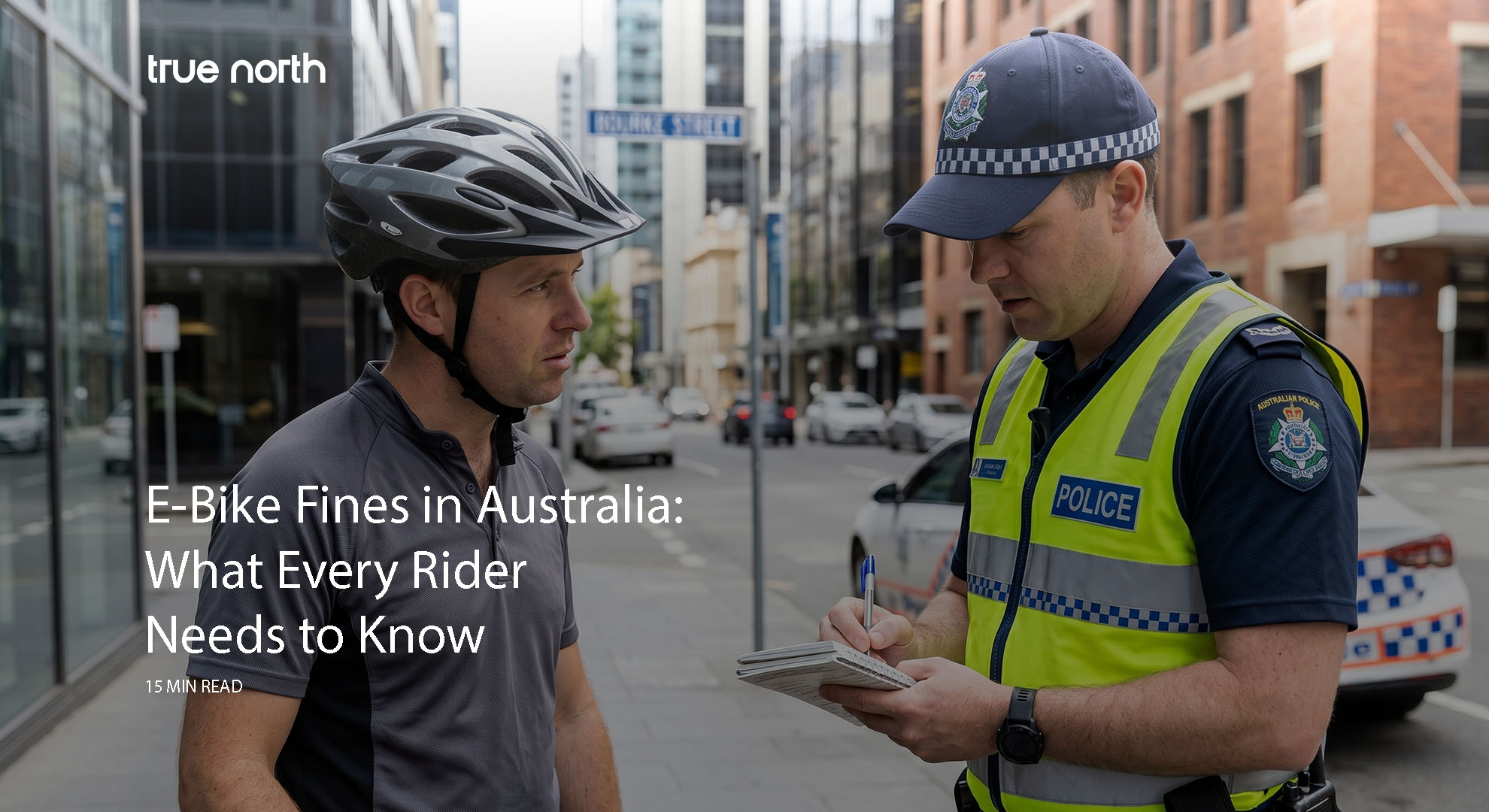
Targeted operations. Dedicated operations like NSW’s Operation Kilowatt and Victoria’s Operation Consider set up intercept points in high-traffic cycling areas. Officers stop riders, check compliance, and issue fines on the spot.
Routine policing. Outside of targeted operations, regular highway patrol and beat officers can issue fines for obvious non-compliance at any time. You don’t need to be caught in an operation to receive a fine.
What about e-bike insurance after a fine?
Receiving a fine for riding a non-compliant e-bike doesn’t just cost you the penalty amount. It can also create an insurance problem.
Most cycling insurance policies require your bike to be legally compliant. If you’ve been fined for riding a non-compliant bike, your insurer may refuse to cover a subsequent theft or accident claim. Some home insurance policies that cover bicycles also exclude e-bikes that don’t meet the legal definition.
Additionally, if you’re involved in an accident while riding a non-compliant e-bike, you’re personally liable for any damage or injury you cause. Without CTP insurance (which non-compliant bikes can’t obtain through the normal bicycle classification), you’re exposed to potentially enormous financial risk.
For more on this, read our guide to e-bike insurance in Australia and our article on what happens if you have an e-bike accident without insurance.
How to avoid e-bike fines entirely
The only reliable way to avoid fines is to ride a compliant e-bike. That means:
- 250W maximum continuous rated power
- Motor cutout at 25 km/h
- Throttle limited to 6 km/h without pedalling
- EN 15194 certified (this is your proof of compliance)
Don’t rely on sellers’ claims. Don’t trust marketplace listings that say “250W” when the bike clearly performs like a 1,000W machine. And don’t assume that limiting or detuning a high-powered bike makes it legal. If the motor is capable of producing more than 250W continuous, it doesn’t meet the standard regardless of any software restrictions.
The EN 15194 certification mark is the single most important thing to look for when buying an e-bike. It’s a third-party tested standard that confirms your bike meets the 250W/25 km/h requirements. Police recognise it, insurers recognise it, and it’s accepted in every state and territory.
For a complete buying guide focused on compliance, see our article on how to buy a legal e-bike in Australia.
Frequently Asked Questions
It varies by state. In NSW, fines start at $686 for riding an unregistered motor vehicle and can exceed $1,000 when stacked with licence and insurance offences. In Queensland, fines range from $330 to $6,700. Victoria can stack fines to over $800. Tasmania charges $1,018 for an unregistered vehicle.
Yes, in some states. NSW and WA have seizure and crushing powers in effect now. Queensland is introducing seizure and destruction powers from July 2026. Victoria can seize bikes as unregistered motor vehicles. Once seized, a bike may not be returned.
Officers use visual inspection (brand markings, throttles, battery size), rider behaviour (excessive speed, throttle-only riding), and in NSW, portable dyno units for roadside speed and power testing. Targeted operations intercept riders in high-traffic areas.
Yes. Since NSW repealed its 500W allowance in March 2026, no Australian state permits 500W e-bikes as bicycles. Existing NSW owners of 500W bikes have a grace period until March 2029. In every other state, 500W has never been legal for road use as a bicycle.
The import restrictions don’t directly change fines, but they cut off the supply of non-compliant bikes from overseas by requiring motor vehicle import approval for any e-bike exceeding 250W. If you bought a non-compliant bike before December 2025, it’s still subject to all state-level enforcement and fines. The restrictions don’t grandfather existing non-compliant bikes.
You’re personally liable for any damage or injury you cause. Without CTP insurance, you could face a civil lawsuit for the full cost of medical treatment, lost income, and other damages suffered by anyone injured in the incident. Read our detailed article on e-bike accidents without insurance.
Summary
E-bike fines in Australia have never been higher, and the enforcement infrastructure is still expanding. NSW leads with seizure and crushing powers, roadside dyno testing, and fines that stack into the thousands. Queensland is introducing the most comprehensive reform package with fines up to $6,700 and seizure powers from July 2026. Victoria’s Operation Consider showed that over half the e-bikes on Melbourne’s streets are non-compliant. And federal import restrictions are tightening the supply side.
The pattern is unmistakable: every state is moving toward tighter enforcement, and the days of riding overpowered e-bikes without consequences are ending.
The simplest way to stay clear of all of this is to ride a bike that’s 250W continuous, EN 15194 certified, and compliant from the day you buy it. The True North Finder is exactly that: EN 15194 certified, 250W continuous, 25 km/h cutout, and legal in every state and territory in Australia at $2,590.
For the full legal picture, see our complete guide to e-bike laws in Australia.