Last Updated: May 2026
Every registered motor vehicle in Australia carries Compulsory Third Party (CTP) insurance. If a car hits a pedestrian, the insurer pays the medical bills. If a motorbike causes a crash, CTP covers the injured party. The system works because the cover is automatic and mandatory.
E-bikes have no such cover. A compliant EPAC is classified as a bicycle, not a motor vehicle. There is no CTP, no green slip, and no automatic insurance of any kind. If you cause an accident on your e-bike and injure someone, the financial consequences fall entirely on you.
This article walks through what actually happens after an e-bike accident when you have no insurance. Not the theory. The real-world costs, the legal process, and what it means for both the rider and the person they injure. For your insurance options, see our guides: Do You Need E-Bike Insurance? and E-Bike Insurance in Australia.
Disclaimer: This article is for general information purposes only and should not be taken as legal, financial, or insurance advice. If you have been involved in an e-bike accident, seek legal advice from a qualified solicitor.
The Scenario Nobody Plans For
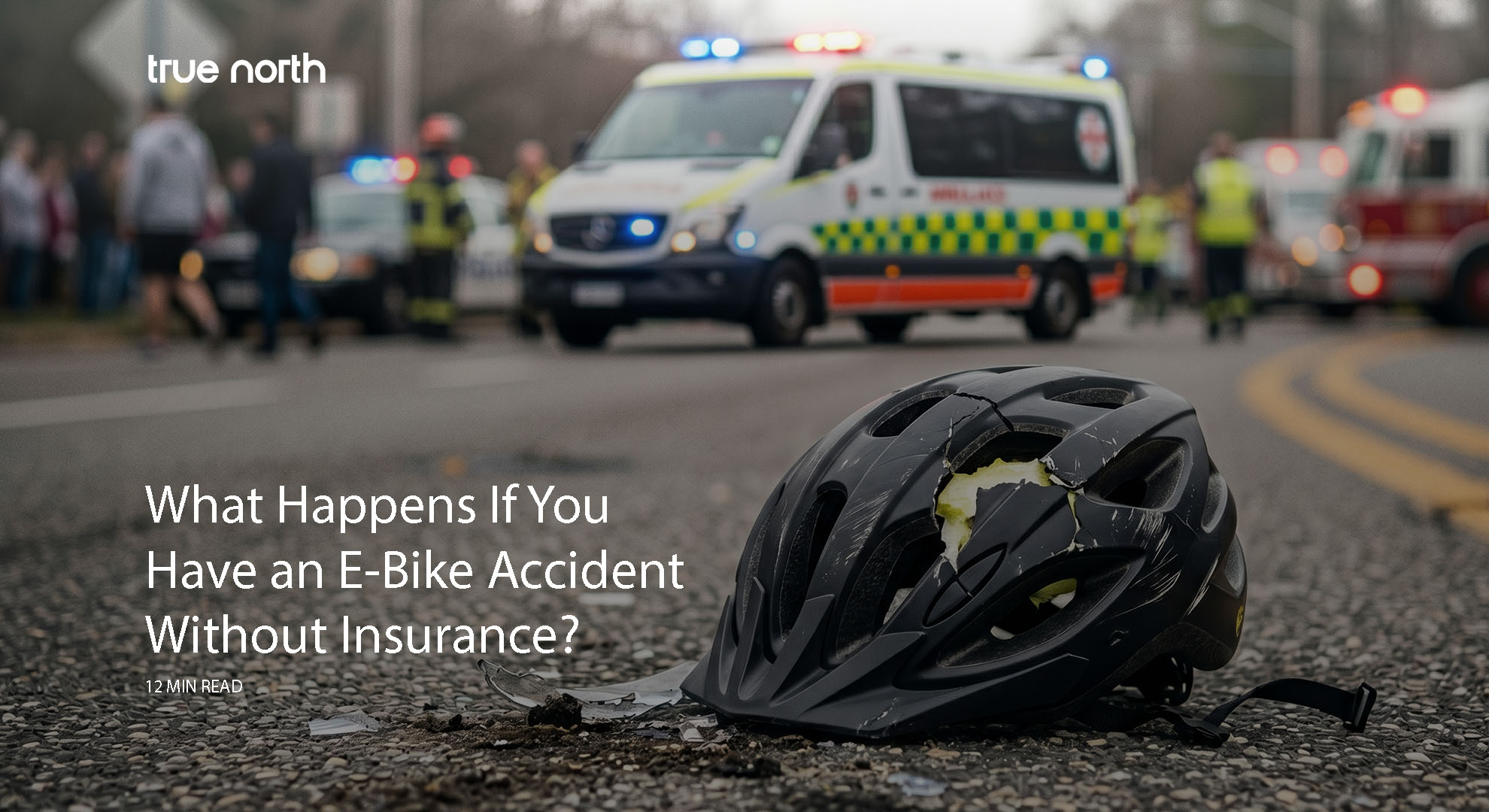
You’re riding your e-bike along a shared path on a Saturday morning. You come around a bend, a pedestrian steps out from behind a parked car, and you collide. The pedestrian falls and breaks their wrist. They hit their head on the ground. An ambulance is called.
In a car, your CTP insurance would cover the pedestrian’s medical bills, rehabilitation, and lost income. The process is established, the insurer manages the claim, and you are not personally exposed beyond your premium.
On an e-bike, none of that applies. There is no CTP. There is no insurer. The pedestrian’s medical bills, rehabilitation costs, lost income, and pain and suffering are either covered by Medicare (for the medical component), their own private health insurance (if they have it), or they are left to pursue you personally for damages.
What It Actually Costs
The costs of an e-bike accident depend on the severity of the injury. Here are realistic ranges based on Australian injury compensation data:
Minor injury (bruising, sprains, soft tissue): The pedestrian is treated at a GP or emergency department, misses a few days of work, and recovers fully. Total costs are modest, typically covered by Medicare. They are unlikely to pursue a personal claim for this level of injury, though they could.
Moderate injury (broken wrist, fractured collarbone, concussion): Emergency treatment, imaging, potential surgery, physiotherapy over several weeks, and time off work. Out-of-pocket costs after Medicare can run to $5,000 to $15,000. If the pedestrian sues for lost income and pain and suffering, a claim could reach $20,000 to $50,000.
Serious injury (traumatic brain injury, spinal injury, multiple fractures): Hospitalisation, surgery, extended rehabilitation, ongoing care needs, significant lost income, and permanent impairment. Claims in this category can reach $100,000 to $500,000 or more. Catastrophic injuries involving permanent disability or ongoing care can exceed $1 million.
These are not abstract numbers. Barrister Andrew Stone SC from the Australian Lawyers Alliance has publicly warned that e-bikes “can weigh as much as motorbikes and if you’re struck and knocked to the ground by one of these devices, you can be left with life-long injuries.” A 25 kg e-bike travelling at 25 km/h carries significant kinetic energy, enough to cause a serious fall on hard pavement.
The Legal Process: What Happens After the Accident
If a pedestrian is injured and wants to seek compensation, the process typically follows this path:
- Step 1: Medical treatment. Medicare covers the immediate medical costs. If the pedestrian has private health insurance, it may cover additional treatment. If they don’t, the gap can be significant for specialist care, physiotherapy, and rehabilitation.
- Step 2: The pedestrian seeks legal advice. A personal injury lawyer will assess whether they have a viable claim against you. The key question is negligence: were you riding carelessly, too fast, without warning, or in breach of road rules?
- Step 3: A claim is made against you personally. Because there is no CTP insurer, the claim is made directly against you as an individual. If you have public liability cover through a cycling membership, the insurer steps in and manages the claim. If you don’t, you are on your own.
- Step 4: Legal costs accumulate. You will need to hire your own solicitor to respond to the claim. Legal costs for defending a personal injury claim can run to $10,000 to $30,000 or more, even before any settlement or judgment.
- Step 5: Settlement or judgment. Most claims settle before reaching court, but the settlement comes from your own assets. If the claim goes to court and a judgment is made against you, the court can order you to pay from your savings, superannuation (in some circumstances), or other assets.
The reality, as injury law firm Arnold Dallas McPherson has noted, is that there is “often little point in suing unless the rider has significant assets.” This is cold comfort for the injured pedestrian, who may be left with medical bills and lost income with no practical way to recover compensation. And it is no comfort for the rider, who faces years of legal proceedings and potential financial ruin if they do have assets.
Five Real-World Scenarios
1. You hit a pedestrian on a shared path
Without insurance: The pedestrian sues you personally. You hire a solicitor. The claim settles for $35,000 for a broken arm, lost income, and pain and suffering. You pay from savings.
With a $120/year cycling membership: Your public liability insurer manages the claim and pays the $35,000 settlement. You pay nothing beyond your membership fee.
2. Your e-bike is stolen from outside a café
Without insurance: You lose a $3,000 bike. Your home insurance won’t cover theft away from home unless you added portable contents cover. You buy a replacement out of pocket.
With specialist e-bike insurance ($300/year): You file a claim. The insurer pays the replacement cost minus your excess (typically $100 to $200). You’re back on a bike within weeks.
3. You crash and injure yourself (no other party involved)
Without insurance: Medicare covers your emergency treatment. If you can’t work for six weeks, you lose six weeks of income. There is no CTP, no workers’ comp (unless it happened during work), and no personal injury claim because there is no other party at fault.
With cycling membership: Many memberships include personal accident benefits. These are limited (typically $500 to $1,000 for non-Medicare medical expenses and modest lump-sum benefits for permanent injury), but they provide some financial cushion.
4. A car hits you
With or without your own insurance: The motorist’s CTP covers your injuries under the Motor Accident Injuries Act (NSW) or equivalent state legislation. You can claim weekly benefits and medical costs for up to 12 months regardless of fault. If you can prove driver negligence, you may claim common law damages.
But if your e-bike was non-compliant: The CTP insurer may argue that you were operating an unregistered motor vehicle, potentially complicating or reducing your claim. This is an emerging area of law, and the outcome may depend on the specific circumstances and jurisdiction.
5. Your battery causes a fire in your apartment
Without insurance: If the fire damages your apartment and the building, you face claims from your landlord, body corporate, and potentially neighbouring residents. Your home and contents policy may exclude “motorised devices.” If the battery was uncertified or modified, the exclusion is almost certain to apply.
With a compliant, EN 15194 certified e-bike: Your home insurance is more likely to cover the claim because the battery was independently tested and certified. Certification doesn’t guarantee cover, but it removes the strongest ground for the insurer to deny the claim.
The Victim’s Perspective: Why This Matters for Everyone
The insurance gap does not just affect riders. It affects anyone who shares a road, path, or footpath with e-bikes.
If you are a pedestrian hit by an e-bike rider who has no insurance, your options are limited. Medicare covers your hospital treatment. Your private health insurance (if you have it) may cover additional care. But lost income, ongoing rehabilitation, home modifications for a disability, and pain and suffering are not covered by Medicare or private health insurance.
Your only avenue for compensation is to sue the rider directly. If the rider has assets, this may succeed. If the rider is a teenager, an international student, or someone without significant savings, a successful judgment may be unenforceable in practice. You win on paper but recover nothing.
This is why safety advocates, lawyers, and the NSW Government are all pushing toward some form of compulsory e-bike insurance. Barrister Andrew Stone SC has described the current situation as leaving both riders and victims “financially exposed.” Until a compulsory scheme is introduced, voluntary insurance is the only protection available.
How Non-Compliance Makes Everything Worse
If your e-bike is non-compliant (over 250 W, non-pedal-assist throttle, or modified to exceed 25 km/h), the insurance consequences compound:
- No cycling membership cover. Memberships cover legal bicycles and EPACs only. A non-compliant bike falls outside the policy. Your $20 million liability cover does not exist.
- No home insurance liability cover. Most policies exclude motor vehicles. A non-compliant e-bike is a motor vehicle under the law.
- No specialist e-bike insurance. Every specialist insurer requires the bike to meet the EPAC definition.
- CTP claims complicated. If a car hits you while you’re riding an illegal bike, the motorist’s CTP insurer may dispute your entitlement to compensation.
- Fines on top of liability. You face fines for riding an unregistered motor vehicle ($686 to $2,200 in NSW), riding uninsured ($686 to $5,500), and potentially riding unlicensed. Your bike may also be seized and crushed.
The total exposure: unlimited personal liability for the pedestrian’s injuries, fines of $2,000 or more, loss of the bike through seizure, and no insurance of any kind. This is the worst-case scenario, and it is entirely preventable.For more on compliance, see our buyer’s compliance guide and our e-bike laws hub.
The Cost of Prevention vs the Cost of a Claim
| Cover Type | Annual Cost | What It Protects Against |
|---|---|---|
| Cycling membership (liability) | Around $120 | $20 million public liability if you injure someone or damage property |
| Specialist e-bike insurance | $250 to $400 | Theft, accidental damage, transit damage, and often liability |
| Home contents (check policy) | $0 additional (if covered) | Theft from home, possibly liability (check for exclusions) |
| No insurance | $0 | Nothing. Full personal exposure to every risk listed above |
A cycling membership costs less than two café coffees per month. It protects you against the one scenario that could change your financial life. Specialist insurance costs roughly $1 per day and covers the bike itself as well.
The cost of a single moderate injury claim ($20,000 to $50,000) exceeds the lifetime cost of cycling membership fees. The cost of a serious claim ($100,000+) exceeds what most Australians have in savings.
Frequently Asked Questions
If you injure someone, they can sue you personally for medical costs, lost income, and damages. There is no CTP or automatic insurance for e-bike riders. You bear the full financial exposure. Legal costs for defending a claim can reach $10,000 to $30,000 before any settlement.
Yes. If you were negligent (riding too fast, not giving warning, not following road rules), the pedestrian can make a personal injury claim against you. Without liability insurance, the claim is against your personal assets.
Medicare covers the medical treatment component (emergency care, hospital, GP visits). It does not cover lost income, rehabilitation costs beyond basic care, home modifications, pain and suffering, or other damages that a personal injury claim would address.
The motorist’s CTP insurance covers your injuries. You can claim weekly benefits and medical costs regardless of fault. If you can prove driver negligence, you may also claim common law damages. However, if your e-bike was non-compliant, the CTP insurer may complicate your claim.
It depends on the severity. A broken arm with lost income might result in a $20,000 to $50,000 claim. A serious head injury or spinal injury could reach $100,000 to $500,000 or more. Catastrophic injuries can exceed $1 million. These claims come directly from your personal assets if you have no insurance.
A cycling organisation membership (Bicycle NSW, AusCycling, or your state body) typically costs under $100 per year and includes around $20 million in public liability cover. This is the most cost-effective protection available.
Summary
An e-bike accident without insurance is a financial catastrophe waiting to happen. The gap between what drivers carry (CTP, comprehensive cover) and what e-bike riders carry (nothing, by default) means that a single collision with a pedestrian can expose you to tens or hundreds of thousands of dollars in personal liability, with no insurer to manage the claim or pay the settlement.
The fix is simple and cheap. A cycling organisation membership costs around $120 per year and provides $20 million in public liability cover. Specialist e-bike insurance costs $250 to $400 per year and covers theft and damage as well. Together, they close the gap for less than $500 per year.
The one non-negotiable: ride a compliant bike. A 250 W, EN 15194 certified EPAC is the legal choice, the insurable choice, and the only choice that keeps every protection available to you.
For your insurance options, see our guides: Do You Need E-Bike Insurance? and E-Bike Insurance in Australia. For NSW-specific cover, see our NSW e-bike insurance guide. Or explore our range of EN 15194 certified e-bikes.