Last Updated: June 2026
Buying your first e-bike in Australia is exciting, but the choices can be overwhelming. Motors, batteries, brakes, sensors, frame materials, tyres, certification stickers, and legal rules all influence which bike is right for you. Retailers don’t always make these distinctions clear, and getting it wrong can mean riding an illegal, uninsurable machine without knowing it.
This guide walks you through every decision in the order that matters most. We start with legal compliance (because nothing else matters if the bike isn’t road-legal), then move through motors, batteries, brakes, tyres, frames, and sensors. Each section gives you enough to make a confident decision, with links to deeper reading where it helps.
For the full legal framework, see our detailed article: E-Bike Laws in Australia (2026): Everything You Need to Know. For a detailed guide on how to verify compliance before purchasing, see our buyer’s compliance guide.
- Continuous power vs peak power
- E-bike throttle rules in Australia
- Do you need insurance for an e-bike?
Disclaimer: This article is for general information purposes only and should not be taken as legal or financial advice. Always check your local laws before riding.
Step 1: Legal Compliance First
Before you think about motors, batteries, or frame styles, you need to answer one question: is this bike legal to ride in Australia?
Since 2026, the rules have tightened significantly. NSW is phasing out its 500 W exception, moving to the national 250 W standard by 1 March 2029. The Federal Government has tightened imports of non-compliant bikes. Queensland is introducing fines of up to $6,700 and seizure powers from July 2026. Police in NSW are trialling roadside dyno testing.
A legal e-bike in Australia must meet the Electrically Power-Assisted Cycle (EPAC) definition:
- 250 W maximum continuous rated power (the number stamped on the motor)
- 25 km/h pedal-assist cut-off (the motor stops helping at this speed)
- Pedal-assist only (throttle limited to 6 km/h walk-assist)
- EN 15194 certification (the European standard accepted in every state)
If a bike meets these requirements, it is treated as a bicycle. No registration, no licence, no compulsory insurance. If it doesn’t, it is an unregistered motor vehicle with fines, seizure risk, and no insurance cover.
The simplest check: look for the EN 15194 certification sticker on the frame. A bike with this sticker has been independently tested and confirmed to meet all four requirements. For more on what this certification covers, read our guide to EN 15194 certification.
Step 2: Choose Your Frame Style
The frame determines how comfortable you are getting on and off the bike, and how the bike handles. For a first-time buyer, this is often the most personal decision.
Step-Through
A step-through frame has a low crossbar (or none at all), allowing you to step through rather than swing your leg over the top. This is the most accessible design: easy to mount and dismount in work clothes, with a bag, or when stopping in traffic. It suits commuters, older riders, shorter riders, and anyone who values convenience over aggressive riding posture.
Despite what some riders assume, a well-designed step-through frame is not weaker or less stable than a traditional frame. Modern alloy construction handles the loads comfortably.
Step-Over (Traditional / Diamond Frame)
A step-over frame has a higher top tube connecting the seat tube to the head tube. This design is slightly stiffer and lighter at the same material cost, which can improve handling at speed. It suits riders who are comfortable swinging their leg over and prefer a sportier riding position.
Which to choose?
If you’re unsure, go step-through. You lose nothing in performance or durability, and you gain significant ease of use for everyday riding. If you prefer the look and feel of a traditional frame and don’t mind the higher mount, step-over is a perfectly good choice.
Step 3: Motor Type — Hub Drive vs Mid-Drive
The motor is the heart of the e-bike. You’ll choose between two types, and both work well for Australian conditions.
Hub Drive Motors
A hub motor sits inside the rear wheel (sometimes the front) and spins the wheel directly. It doesn’t interact with the chain or gears, which makes it simple, quiet, and low-maintenance.
Hub drives suit commuters, flat-to-moderate terrain, and riders who value reliability and low ownership costs. They are the most common motor type in the sub-$4,000 price range.
The trade-off: hub motors don’t use your gears, so they can feel less efficient on steep hills compared to a mid-drive at the same wattage. That said, a quality 250 W hub motor with good torque (40 Nm to 50 Nm) handles suburban hills comfortably.
Mid-Drive Motors
A mid-drive motor sits at the crank near the pedals and drives through the chain. Because it uses your gears, it can keep the motor in an efficient range and deliver strong torque on climbs. The ride feel is more natural, especially when paired with a torque sensor.
Mid-drives suit hilly terrain, off-road riding, and riders who want the most bike-like ride feel. Premium systems from Bosch, Shimano, and Bafang’s mid-drive line are reliable and well-supported.
The trade-off: mid-drives are more complex and usually more expensive. The motor torque passes through the chain and cassette, which increases drivetrain wear. Servicing may require specialist tools.
Which to choose?
For most first-time buyers riding in Australian cities and suburbs, a quality hub motor is the practical choice. It’s simpler, cheaper to maintain, and performs well on typical urban terrain. If you live in a hilly area or plan to ride off-road regularly, a mid-drive is worth the premium.
For the full comparison, read our article on mid-drive vs hub motors.
Step 4: Battery Capacity and Range
The battery determines how far you can ride on a single charge. This is one of the most common concerns for first-time buyers, and it’s also where marketing claims are most misleading.
Understanding the numbers
Battery capacity is measured in watt-hours (Wh), which equals volts (V) multiplied by amp-hours (Ah). Watt-hours is the single best number for comparing batteries, because it reflects total stored energy.
- 360 to 500 Wh: Typically provides 30 to 60 km of range in mixed riding conditions
- 480 to 700 Wh: Typically provides 50 to 100 km
- 700 Wh and above: 80 km or more, depending on conditions
Why real-world range differs from advertised range
Manufacturers often quote range at the lowest assist level, on flat terrain, with a lightweight rider. Your actual range depends on assist level (higher assist drains faster), terrain (hills consume significantly more energy), rider weight, tyre type (fat tyres use more energy than city tyres), headwind, and temperature.
A practical rule: expect roughly 50% to 70% of the manufacturer’s maximum range in typical mixed riding. If a bike claims 120 km maximum range, plan for 60 to 85 km in real-world conditions.
48 V vs 36 V
Most modern e-bikes use either 36 V or 48 V systems. A 48 V setup delivers the same power with less current, which means cooler operation, less component strain, and a more responsive feel on hills and starts. For Australian conditions, 48 V is preferable for most riders.
Charging
Most e-bike batteries charge fully in 3 to 5 hours from a standard wall outlet. If you commute 15 km each way, you’ll likely charge once or twice a week rather than daily.
For the full battery guide, read our article on e-bike batteries.
Step 5: Brakes — Don’t Compromise Here
Brakes are the most important safety component on an e-bike. E-bikes are heavier and often faster than regular bicycles, which means more kinetic energy to manage when stopping. This is not the place to save money.
Hydraulic disc brakes (recommended)
Hydraulic disc brakes use fluid pressure to push brake pads against a rotor attached to the wheel hub. They provide strong, consistent stopping power with minimal hand effort. They self-adjust as pads wear and perform reliably in wet conditions. Look for:
- Two-piston hydraulic: Standard on most mid-range e-bikes ($2,000 to $3,000). Good performance for commuting and flat-to-moderate terrain
- Four-piston hydraulic: Premium stopping power with better heat dissipation on long descents. Recommended for heavier riders, hilly terrain, or cargo loads
Mechanical disc brakes (budget option)
Mechanical disc brakes use a cable rather than fluid. They are cheaper but require more hand force, need more frequent adjustment, and typically push only one pad against the rotor. They work, but on an e-bike you will notice the difference compared to hydraulics.
What to test
On a test ride, brake hard from 25 km/h. The bike should stop quickly and smoothly without pulling to one side. If the brakes feel spongy, weak, or squeal excessively, the bike may have lower-quality components.
For the full breakdown, read our e-bike brakes guide: hydraulic vs mechanical.
Step 6: Tyres — Fat vs City
Tyre choice affects ride feel, efficiency, range, and weight more than most buyers expect.
City / commuter tyres (700C or 27.5″ × 1.5″ to 2.5″)
Lighter, faster-rolling, and more efficient on paved surfaces. They give you the best range per charge, sharper handling in traffic, and a lighter overall bike. If you’re commuting on roads and bike paths, city tyres are the practical choice.
Fat tyres (3.8″ to 5″)
Wide, cushioning, and stable on loose surfaces like sand, gravel, and mud. Fat tyres act as natural suspension and provide a comfortable ride on rough streets. The trade-offs are significant: they’re heavier, create more rolling resistance, and can reduce range by 20% or more compared to city tyres. The bike will also be heavier and less nimble.
Which to choose?
If you ride on paved surfaces 80% of the time or more, city tyres will give you better performance and range. If you regularly ride on sand, gravel, or unsealed trails, or if you simply prefer the look and feel of a fat tyre bike, they’re a valid choice — just expect a heavier bike and more frequent charging.
For the full comparison, read our article on fat tyres vs city tyres.
Step 7: Sensors — Torque vs Cadence
The sensor determines how the motor responds to your pedalling. This is a subtle but important difference in ride quality, and it’s one of the biggest factors in whether your e-bike feels like a bicycle or a motor vehicle.
Torque sensor (recommended)
A torque sensor measures how hard you push the pedals and delivers proportional assistance. Push harder on a hill, and the motor pushes harder with you. Ease off on a flat, and the assistance fades. The result feels natural and intuitive, like the bike is amplifying your own power rather than a motor pushing you from behind. It preserves the feeling of riding a bike, just with more capability.
Torque sensors also use battery power more efficiently because assistance scales with effort. Light pedalling draws less power. Hard pedalling draws more. Your battery lasts longer as a result.
If you want a bike feel, but enhanced, go with torque.
Cadence sensor
A cadence sensor detects whether the pedals are turning and delivers a fixed level of assistance based on your selected mode. It does not measure how hard you push, only whether you are pushing at all. This means the motor delivers full power the moment you start pedalling, regardless of effort.
The advantage is a strong, immediate pull from a standstill, which some riders enjoy. The disadvantage is that the power delivery can feel jerky, particularly at lower speeds where the motor kicks in at full force as soon as the cranks turn. Many riders describe cadence-sensor bikes as feeling “motorised” rather than “assisted.” Battery efficiency is also lower because the motor delivers maximum power even when you are pedalling lightly.
Cadence sensors are more common on budget bikes because the components are cheaper. They work, but the ride quality difference compared to a torque sensor is noticeable from the first pedal stroke.
Which to choose?
If you want the ride to feel like a better version of cycling, choose torque. If you want maximum pull off the line and are less concerned about natural feel, or if budget is a primary constraint, cadence will do the job.
For the full comparison, read our article on torque vs cadence sensors.
Step 8: Frame Material — Aluminium vs Steel
Aluminium (alloy)
Lighter, rust-resistant, and stiffer. Aluminium is the standard for modern e-bikes because it keeps weight down (important for a bike that already carries a motor and battery) and resists corrosion in Australian coastal and urban conditions. Most e-bikes in the $2,000 to $5,000 range use aluminium frames.
Steel
Heavier but more flexible, which gives a smoother ride quality over bumps. Steel is durable and can be repaired if cracked (aluminium cannot). It is more susceptible to rust if the paint is chipped. Steel frames are less common on modern e-bikes but appeal to riders who prefer a classic ride feel.
Which to choose?
For most first-time buyers, aluminium is the practical choice. It’s lighter, lower maintenance, and well-suited to Australian conditions. Steel is a legitimate option if you value ride comfort over weight savings and are willing to maintain the finish.
For the full comparison, read our article on aluminium vs steel e-bike frames.
Step 9: Weight — The Factor Most First-Time Buyers Underestimate
Weight is probably the biggest factor people overthink on paper and underestimate in practice. Most fat tyre e-bikes on the market weigh between 38 kg and 45 kg including the battery. That might sound manageable until you need to carry it up a flight of stairs to your apartment, lift it onto a car rack on a Saturday morning, navigate it through a train station, or pick it up off the ground to get it close enough to a pole or bike rack to lock it.
For riders who commute and store their bike at work, weight becomes a daily consideration, not a spec sheet number. If your office is up a flight of stairs, or your apartment doesn’t have ground-floor storage, a 40 kg bike turns every arrival and departure into a workout.
This is one of the most common reasons people cite when buying their second e-bike. Their first bike had the right motor and the right range, but it was too heavy to live with day to day. They didn’t think about it in the shop, but they think about it every time they lift it.
The True North Finder weighs approximately 18 kg including battery. That’s less than half the weight of a typical fat tyre e-bike. It handles like a regular city bike when the motor is off, it’s easy to carry up a few steps, and it doesn’t require two people to load onto a car. If you plan to integrate an e-bike into your daily routine rather than ride it occasionally on weekends, weight deserves as much attention as motor power or battery range.
Step 10: Drivetrain — Chain vs Belt Drive
Chain drive
The standard drivetrain for most bicycles and e-bikes. Chains are cheap to replace, compatible with multi-speed gearing, and available everywhere. The trade-offs: they need regular lubrication, stretch over time, attract dirt, and can rust if neglected. They can also leave grease on your clothes if your leg brushes the chain while riding, which is a common annoyance for commuters in work clothes.
Belt drive (recommended)
A carbon belt drive is silent, maintenance-free, and clean. There is no grease, no oiling, no chain stretch, and no rust. Your clothes stay clean even if they brush the drivetrain. Belts last significantly longer than chains and require zero routine maintenance beyond occasionally wiping them down.
The trade-off is that belt drives are typically single-speed, which means the motor must compensate for hills rather than a gear system. On a quality e-bike with a torque sensor and strong motor, this works well. The motor provides the “gearing” by adjusting assistance to match the terrain, and you avoid the weight, complexity, and maintenance of a derailleur system entirely.
For commuters and daily riders, belt drive is the superior choice. If you need multiple gears for extreme terrain variation or prefer the lowest possible upfront cost, chain drive is the standard.
Step 11: What to Avoid
| Risk Area | What to Watch For | Why It Matters |
| Grey imports and uncertified bikes | Direct purchases from overseas sellers (Alibaba, AliExpress, direct-from-factory) | These bikes may lack EN 15194 certification, have uncertified batteries, or non-compliant throttles. Non-compliant bikes can be intercepted at the border, but some still slip through |
| “Digitally limited” motors | 750 W or 1,000 W motors claimed to be “software limited to 250 W” | The law recognises the motor’s rated power, not software limits. This makes the bike non-compliant. Walk away |
| Bikes without certification | No EN 15194 certificate or missing certification sticker on the frame | A compliant bike will always have documentation. If it’s missing, there’s a high risk the bike is not road legal |
| Unlockable speed or power modes | Salesperson offers to “unlock” higher speed or power after purchase | This effectively turns the bike into an unregistered motor vehicle. You take on legal and safety risk |
For the full list of traps to avoid, read our buyer’s compliance guide.
Which True North Bike Is Right for You?
The True North Finder is available in two frame styles, both EN 15194 certified and legal in every Australian state.
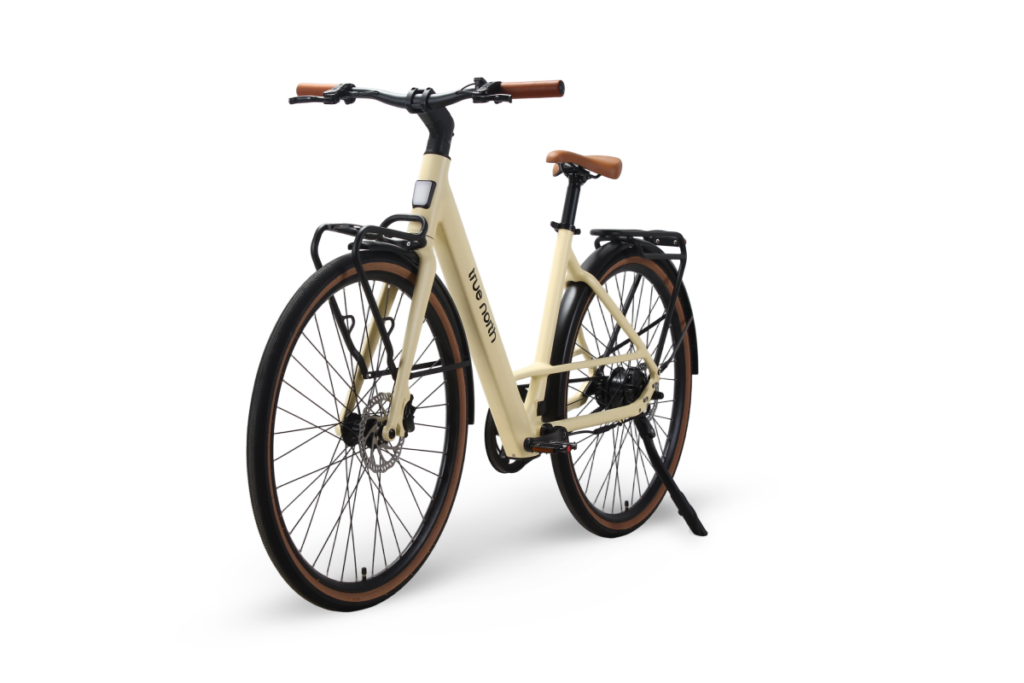
True North Finder Step-Through: The step-through frame is designed for easy mounting and dismounting. It suits commuters, older riders, shorter riders, and anyone who values everyday convenience. 250 W motor with 450 W peak, torque sensor, carbon belt drive, hydraulic disc brakes, 120 km maximum range, and 18 kg total weight.
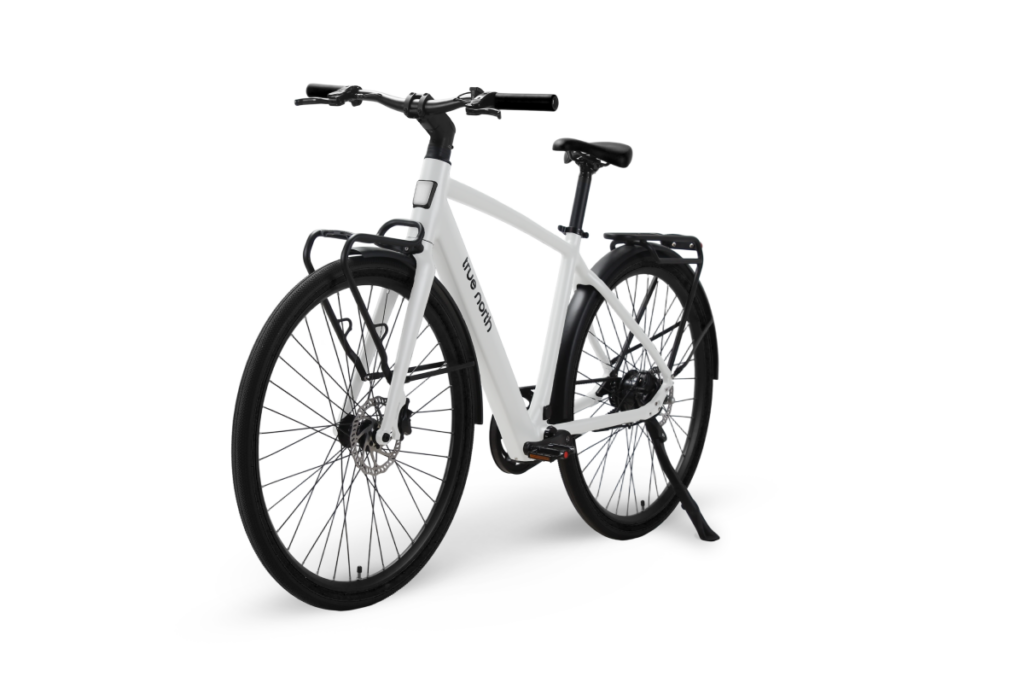
True North Finder Step-Over: The step-over frame offers a traditional riding position with a slightly stiffer feel. Same motor, battery, drivetrain, and brakes as the step-through. It suits riders who prefer a sportier posture and are comfortable with a higher top tube.
Both models share the same core platform: EN 15194 certified, 250 W continuous (450 W peak), 48 V 480 Wh battery, torque sensor, carbon belt drive, two-piston hydraulic disc brakes, and integrated front and rear lighting. The only difference is the frame geometry.
First-Timer Checklist: Before You Buy
| Check | What to Look For | Why It Matters |
| Motor label | Must read 250 W continuous | A 500 W bike is road-legal in NSW until 2029 but not in other states; anything higher isn’t road-legal anywhere, regardless of software settings |
| EN 15194 certification | Sticker on frame with manufacturer name, “EPAC according to EN 15194,” power, speed, serial number, CE mark | The only standard that proves both safety and road compliance |
| Throttle | Use it without pedalling — it should cut out at 6 km/h | If the bike accelerates past 6 km/h on throttle alone, it is not a legal EPAC |
| Brakes | Brake hard from 25 km/h — should stop quickly and smoothly without pulling | E-bikes are heavier and faster than regular bikes. Weak brakes are a safety risk |
| Battery capacity | Compare Wh (watt-hours), not Ah alone | Wh reflects total stored energy and gives a realistic picture of range |
| Sensor type | Ask whether it uses a torque or cadence sensor | Torque sensors deliver a more natural ride feel and better battery efficiency |
| Charger | Look for the RCM mark on the charger | Confirms it meets Australian electrical safety standards |
| Documentation | Ask for the EN 15194 certificate or Declaration of Conformity | A reputable seller will have this readily available. If they can’t produce it, be cautious |
| Test ride | Ride on a hill, in traffic, and at speed | Checks motor smoothness, braking confidence, and overall comfort |
Frequently Asked Questions
Start with legal compliance: the motor must be 250 W continuous, pedal-assist with a 25 km/h cut-off, and EN 15194 certified. After that, choose based on your riding needs: frame style (step-through vs step-over), motor type (hub vs mid-drive), battery capacity (higher Wh for longer rides), and brake quality (hydraulic disc is strongly recommended).
Quality e-bikes in Australia typically cost between $2,000 and $5,000. Below $2,000, you’re likely to find cadence sensors, mechanical brakes, and lower-quality components. Between $2,500 and $4,000 is the sweet spot for commuters: you get torque sensors, hydraulic brakes, quality batteries, and EN 15194 certification.
No, provided your bike meets the EPAC definition (250 W, pedal-assist, 25 km/h cut-off). However, Queensland is introducing a licensing requirement from July 2026 for riders over 16. No other state currently requires a licence.
Yes. A quality 250 W motor produces 400 W to 600 W in peak bursts for hills and acceleration. The number that determines hill-climbing ability is torque (measured in Nm), not watts. A 250 W motor with 45 Nm of torque will climb hills more effectively than a cheap 500 W motor with 35 Nm.
If you ride mostly on paved surfaces (roads, bike paths, footpaths), city tyres give better range, speed, and handling. If you regularly ride on sand, gravel, or rough trails, fat tyres provide more stability and cushioning. Most first-time buyers are best served by city tyres.
You can, but it carries significant risk. Grey imports may lack EN 15194 certification, have uncertified batteries, or feature non-compliant throttles. The Federal Import Ban is intercepting non-compliant bikes at the border. Buying from an Australian retailer with local warranty support and certified stock is the safer option.
Summary
Choosing your first e-bike comes down to a handful of decisions, and they matter in a specific order. Legal compliance first: 250 W, 25 km/h, pedal-assist, EN 15194 certified. Then frame style (step-through for convenience, step-over for sporty), motor type (hub for simplicity, mid-drive for hills), battery capacity (higher Wh for longer rides), brakes (hydraulic disc, always), tyres (city for paved, fat for off-road), and sensor (torque for the best ride feel).
Get the compliance right and everything else follows. You ride legally on every road and path in Australia. You’re insurable. Your bike can’t be seized. And you enjoy the freedom that e-bikes were designed to provide: no registration, no licence, no road tax, just riding.
For the full legal picture, see our hub article: E-Bike Laws in Australia (2026): Everything You Need to Know. Or explore our range of EN 15194 certified e-bikes.