Last Updated: July 2026
NSW e-bike laws are changing in stages between 2026 and 2029. New e-bikes sold in NSW must now be marked to show whether they meet the EN 15194 standard or not. This matters because from March 2029, e-bikes that aren’t certified to EN 15194 will no longer be legal to ride on roads, cycleways, shared paths or other public areas in NSW.
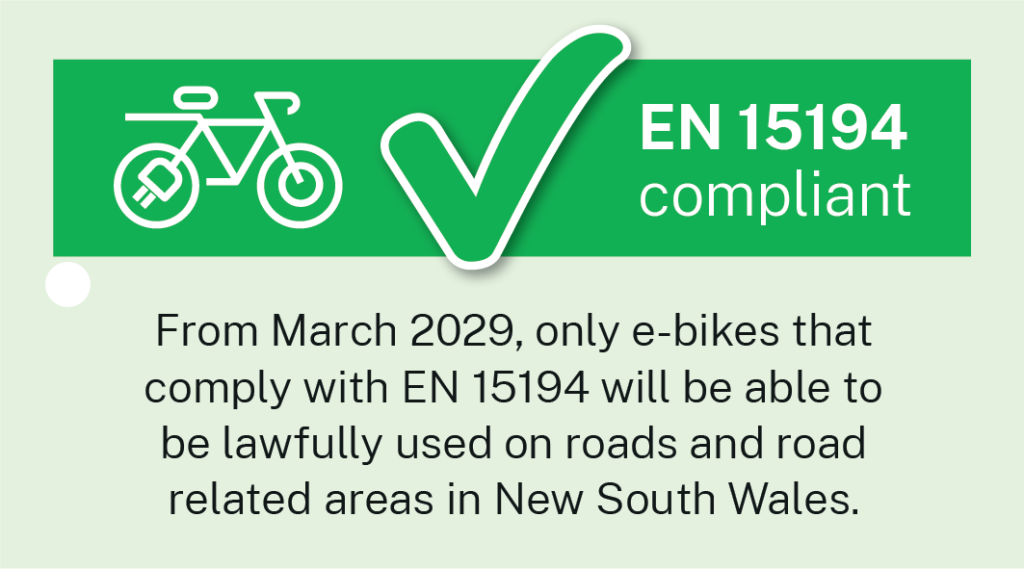
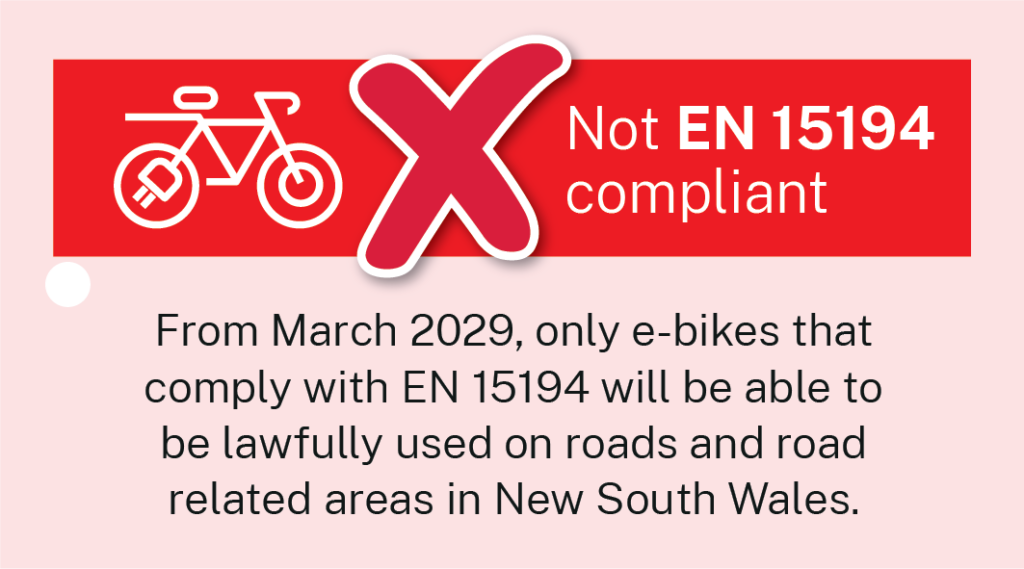
The 500 W on-road power limit still applies in NSW until 1 March 2029, after which only 250 W EN 15194-certified e-bikes will be road-legal. If you’re buying now, a 250 W EN 15194 certified bike is the only future-proof choice. It’s legal today and will stay legal beyond 2029, in every state.
This article explains exactly what changed, when it changed, and what it means for you as a rider or buyer in NSW. For the national picture, see our hub article: E-Bike Laws in Australia. We’ve also written detailed explainers on the topics that cause the most confusion:
- Continuous power vs peak power
- E-bike throttle rules in Australia
- The 1000 W debate: what’s legal and what’s not
- What is EN 15194 certification?
- Do you need insurance for an e-bike in Australia?
Disclaimer: This article is for general information purposes only and should not be taken as legal advice. Laws and regulations may change. Always check with Transport for NSW for the most current requirements.
What Changed in NSW in 2026?
NSW was the only Australian state to allow e-bikes with a motor rated up to 500 W continuous. That exception, introduced in 2023 to support riders in hilly areas and cargo bike users, created a regulatory problem. A bike purchased legally in Sydney was technically an illegal, unregistered vehicle the moment you crossed the border into Victoria or Queensland.
In December 2025, the NSW Government announced a reversal with a staged transition toward the European EN 15194 standard. Here is a summary of the key changes:
- March 2026: Transport for NSW recommends that consumers purchase an EN 15194-compliant e-bike, explaining that it is legal now and will remain legal after the transition. (NSW Government)
- Transition until 1 March 2029: NSW is phasing out its higher 500 W allowance. A compliant 500 W e-bike stays road-legal to ride during this transition.
- From 1 March 2029: Only EN 15194-compliant e-bikes will be road-legal in NSW. Owners of higher-powered bikes will need to move to a compliant model by then.
If you’re shopping for an e-bike in NSW and want it to stay legal beyond the change, or to hold its resale value, the advice is simple: choose one certified to EN 15194.
What Makes an E-Bike Legal in NSW Now?
If you’re buying today, choose an Electrically Power-Assisted Cycle (EPAC) certified to EN 15194. It’s road-legal now, it stays legal after the 1 March 2029 change, and it’s legal in every other state. Look for:
- Maximum continuous rated power: 250 W (the EN 15194 standard, legal now and beyond 2029)
- Pedal-assist only: The motor must provide assistance only while you are pedalling
- Speed cut-off: Motor assistance must progressively reduce and stop entirely at 25 km/h
- Throttle limit: A throttle may assist without pedalling up to 6 km/h only (walk-assist mode). Beyond 6 km/h, the motor must only operate while you are pedalling
- Certification: Must be certified to EN 15194 (or an equivalent accepted standard)
The 200 W “power-assisted pedal cycle” category also remains legal, though most modern e-bikes on the market are EPACs.
For the official requirements, see Transport for NSW: E-Bikes.
What About Existing 500 W E-Bike Owners?
If you own a 500 W e-bike, you may continue riding it on NSW roads and paths until 1 March 2029. The 500 W limit stays in force until then, so there’s no purchase-date condition.
After 1 March 2029, all e-bikes over 250 W (or that don’t meet EN 15194) become illegal to ride in public, regardless of when they were purchased. The bike would then be classified as an unregistered motor vehicle.
During the grace period, your 500 W bike is legal in NSW only. It is not road-legal in Victoria, Queensland, or any other state. If you travel interstate with it, you are riding an unregistered motor vehicle.
Can Retailers Still Sell 500 W E-Bikes?
It’s more nuanced than a simple yes or no. There’s no NSW road rule that bans selling a 500 W e-bike, because the 500 W on-road limit applies until 1 March 2029. What changed is certification: from 1 February 2026, any e-bike sold in NSW (with its battery and charger) must be tested, certified and marked for electrical and fire safety, or the seller risks penalties up to $825,000. That requirement is about safety, not motor power.
In practice, new 500 W stock is drying up fast. The December 2025 federal import rules make non-compliant bikes very hard to bring into the country, and the market has shifted to the EN 15194 (250 W) standard that becomes mandatory in 2029. So while a certified 500 W bike isn’t automatically illegal to sell or ride today, buying one now means replacing it by 2029, which is why we only stock and recommend 250 W EN 15194 models.
Whether a specific 500 W model can still be legally retailed depends on its certification status. Always confirm current requirements with NSW Fair Trading and Transport for NSW.
Continuous Power vs Peak Power: Why It Matters in NSW
One of the most common sources of confusion is around motor power ratings. Many e-bike brands sell higher-powered motors (750 W or 1,000 W) and claim they are “speed-limited” or “digitally restricted” to comply with the law.
NSW law is clear: it is the motor’s continuous rated power that determines legality, not peak power and not software limits.
- Continuous power is the sustained output the motor can produce over time without overheating. This is the number printed on the motor housing and it is the number regulators, police, and insurers rely on.
- Peak power refers to brief bursts of higher output, often used for hill starts. A motor rated at 250 W continuous might produce 400 W or more in short bursts. That is legal, because the continuous rating is what counts.
If a motor is labelled 1,000 W and the seller says it’s “limited to 250 W via settings,” the law disagrees. The hardware rating on the motor is what matters. Software can be changed; the motor stamp cannot.
For a deeper explanation, read our article on continuous power vs peak power.
Fines and Penalties in NSW
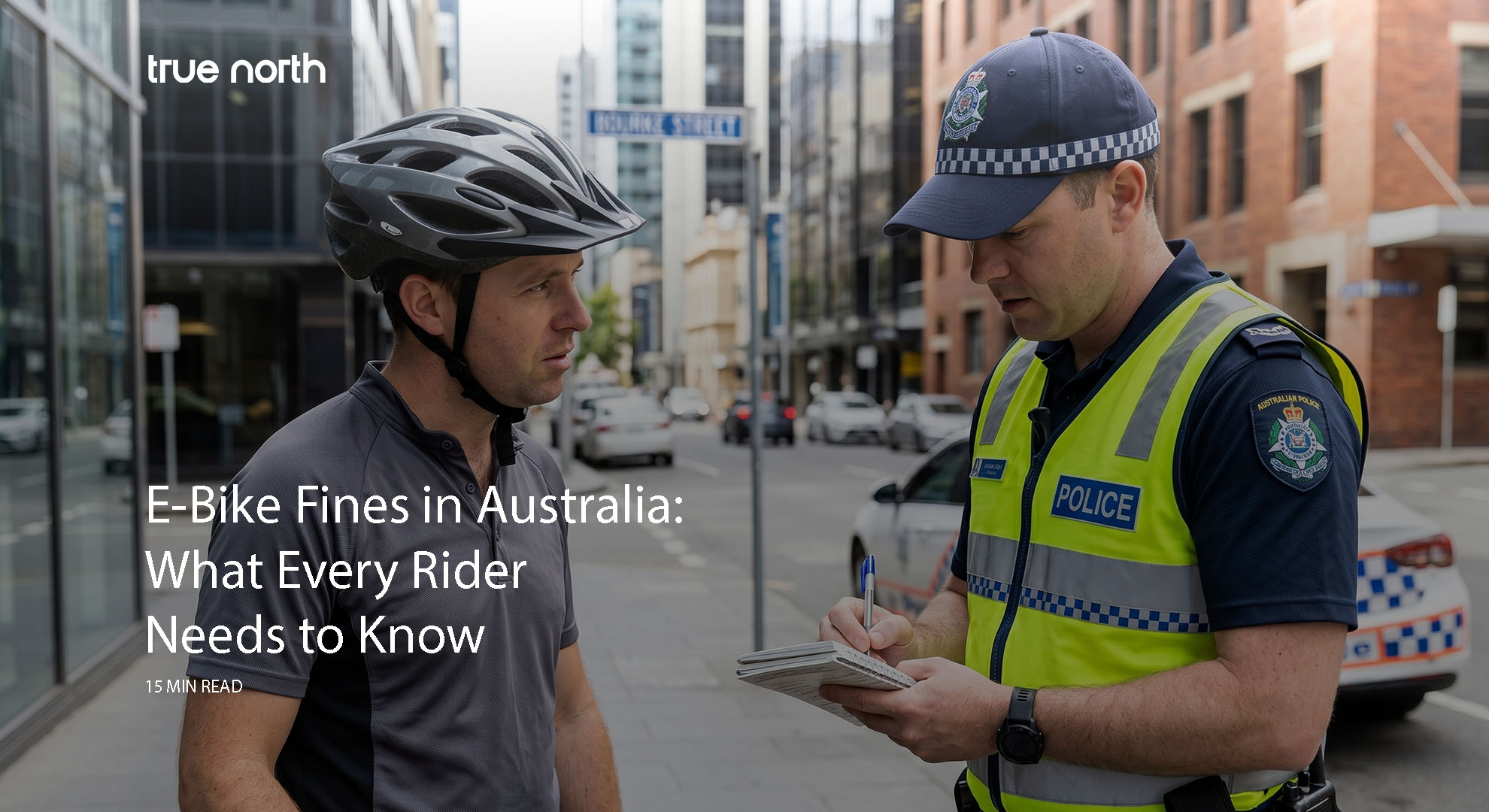
Enforcement has intensified. In 2025, NSW Police ran “Operation Kilowatt” on Sydney’s Northern Beaches, identifying 28 non-compliant e-bikes in a single month. Riders faced fines of $818 per offence for illegal e-bike use, plus additional penalties.
If your e-bike exceeds the legal power limit or uses a non-compliant throttle, you could face:
- Riding an unregistered motor vehicle: fines between $686 and $2,200
- Riding an uninsured motor vehicle: fines between $686 and $5,500
- Riding unlicensed: fines between $572 and $2,200
- Not wearing a helmet: $410
- Bike seizure: Police can confiscate your bike on the spot
- Crushing: Under the March 2026 laws, seized non-compliant bikes may be destroyed and will not be returned
NSW Police are also trialling portable dyno units for roadside power and speed testing. This means officers can test your bike’s output at the scene rather than relying on visual inspection alone.
Throttle Rules in NSW
NSW throttle rules are straightforward:
- Below 6 km/h: A throttle may propel the bike without pedalling (walk-assist mode)
- Above 6 km/h: The motor may only operate while you are simultaneously pedalling. The moment you stop pedalling, the motor must stop
If your bike allows you to cruise at speed using the throttle alone without pedalling, it is not classified as a bicycle. It is an unregistered motor vehicle, and riding it carries the penalties listed above.
For a full breakdown, see our article on e-bike throttle rules in Australia.
Battery Safety and Certification
Battery safety has become a major focus in NSW. There has been a surge in lithium-ion battery fires linked to poorly manufactured imports and uncertified chargers.
From February 2026, all e-mobility products sold in NSW must have a Certificate of Approval and carry a safety marking. The battery and charger must be independently lab-tested. When buying, check for:
- EN 15194 certification on the bike (which includes battery safety testing under EN 50604-1)
- RCM mark on the charger, confirming it meets Australian electrical safety standards. Learn more about RCM at the EESS website
- Manufacturer documentation including a Declaration of Conformity
Avoid purchasing replacement batteries or chargers from unverified online sellers. A cheap battery is not a saving if it causes a fire.
How to Check If Your E-Bike Is Legal in NSW
Use this checklist before purchasing or riding:
- Check the motor label. Look for the continuous rated power stamped on the motor housing. For a future-proof bike, choose 250 W certified to EN 15194. A 500 W EPAC is still road-legal in NSW until 1 March 2029, but it won’t be compliant after that date and isn’t legal in any other state.
- Verify EN 15194 certification. A compliant bike should display a permanent label showing: the manufacturer’s name, the words “EPAC according to EN 15194,” the motor’s continuous rated power, the pedal-assist cut-off speed (25 km/h), a serial number, and the CE mark. If any of these are missing, ask the retailer for clarification.
- Check it’s safety-certified for sale in NSW. From 1 February 2026, e-bikes, batteries and chargers sold in NSW must be electrically tested, certified and marked under NSW Fair Trading rules. You can check a model against Fair Trading’s register of certified products.
- Test the throttle. The motor should only engage without pedalling at walking speed (up to 6 km/h). If it powers the bike at higher speeds without pedalling, the bike is not legal.
- Check the charger. Look for the RCM mark on the charger.
- Ask for documentation. A reputable seller can provide the EN 15194 certificate or Declaration of Conformity.
- Ignore “digitally limited” claims. If a motor is stamped above 500 W, no software setting makes it road-legal in NSW. And anything above 250 W won’t meet the EN 15194 standard that becomes mandatory in 2029, so 250 W is the only future-proof choice.
Minimum Riding Age
An expert review is currently underway to determine a legal minimum riding age for e-bikes in NSW. The review is expected to recommend an age between 12 and 16, and will also consider whether young riders should be permitted to carry passengers. There is currently no formal minimum age for e-bikes in NSW, but this is expected to change. We will update this section when the review is finalised.
Where Can You Ride in NSW?
A legal EPAC is treated as a bicycle. You can ride on:
- Roads: All public roads where bicycles are permitted. Obey all traffic rules
- Bike lanes and cycleways: Full access
- Shared paths: Keep left, give way to pedestrians, ride at a safe speed, and use your bell when passing
Footpaths: Adults cannot ride on footpaths in NSW. Children under 16 (and adults accompanying them) may ride on footpaths. Motorways and roads signed “No Bicycles” are off-limits.
Frequently Asked Questions
Yes, for now. Under the NSW Road Rules, a 500 W EPAC remains legal to ride until 1 March 2029, regardless of when it was bought. From that date, only EN 15194-certified (250 W) e-bikes will be road-legal. Separately, new e-bikes sold from 1 February 2026 must be electrically safety-certified under NSW Fair Trading rules.
Yes. A legal 500 W EPAC can be ridden on NSW roads and paths until 1 March 2029, whenever you bought it. After that date it will be treated as an unregistered motor vehicle. Note that a 500 W bike is not legal in any other Australian state, so it can’t be ridden interstate.
You face fines for riding an unregistered motor vehicle ($686 to $2,200), riding uninsured ($686 to $5,500), and potentially riding unlicensed ($572 to $2,200). Police can also seize your bike, and under the March 2026 laws, it may be crushed.
EN 15194 is the European standard for Electrically Power-Assisted Cycles. It tests safety (frame, battery, electrical systems) and road compliance (250 W power limit, 25 km/h cut-off, pedal-assist requirement). A bike with EN 15194 certification is road-legal in NSW and every other Australian state.
It is not legally required for a compliant EPAC, but it is strongly recommended. Because legal e-bikes are classified as bicycles, they don’t carry compulsory third-party insurance. If you cause an accident, you are personally liable. Read our full guide: Do You Need Insurance for an E-Bike in Australia?
Summary
NSW e-bike rules are in a staged transition. The 500 W on-road limit still applies until 1 March 2029, when the 250 W EN 15194 standard takes over. Alongside that, new e-bikes sold from February 2026 must be electrically safety-certified (penalties up to $825,000 for non-compliant sales), federal import rules have tightened since December 2025, and police can now seize and crush e-bikes that perform like motorbikes.
If you’re buying an e-bike in NSW today, the smart, future-proof choice is a 250 W, EN 15194 certified model. It’s road-legal in NSW now, it stays legal beyond 2029, and it’s road-legal in every other state if you travel.
For the full national picture, see our article: E-Bike Laws in Australia (2026): Everything You Need to Know. Or explore our range of EN 15194 certified e-bikes.